
What is the difference between the powers of God & Satan?
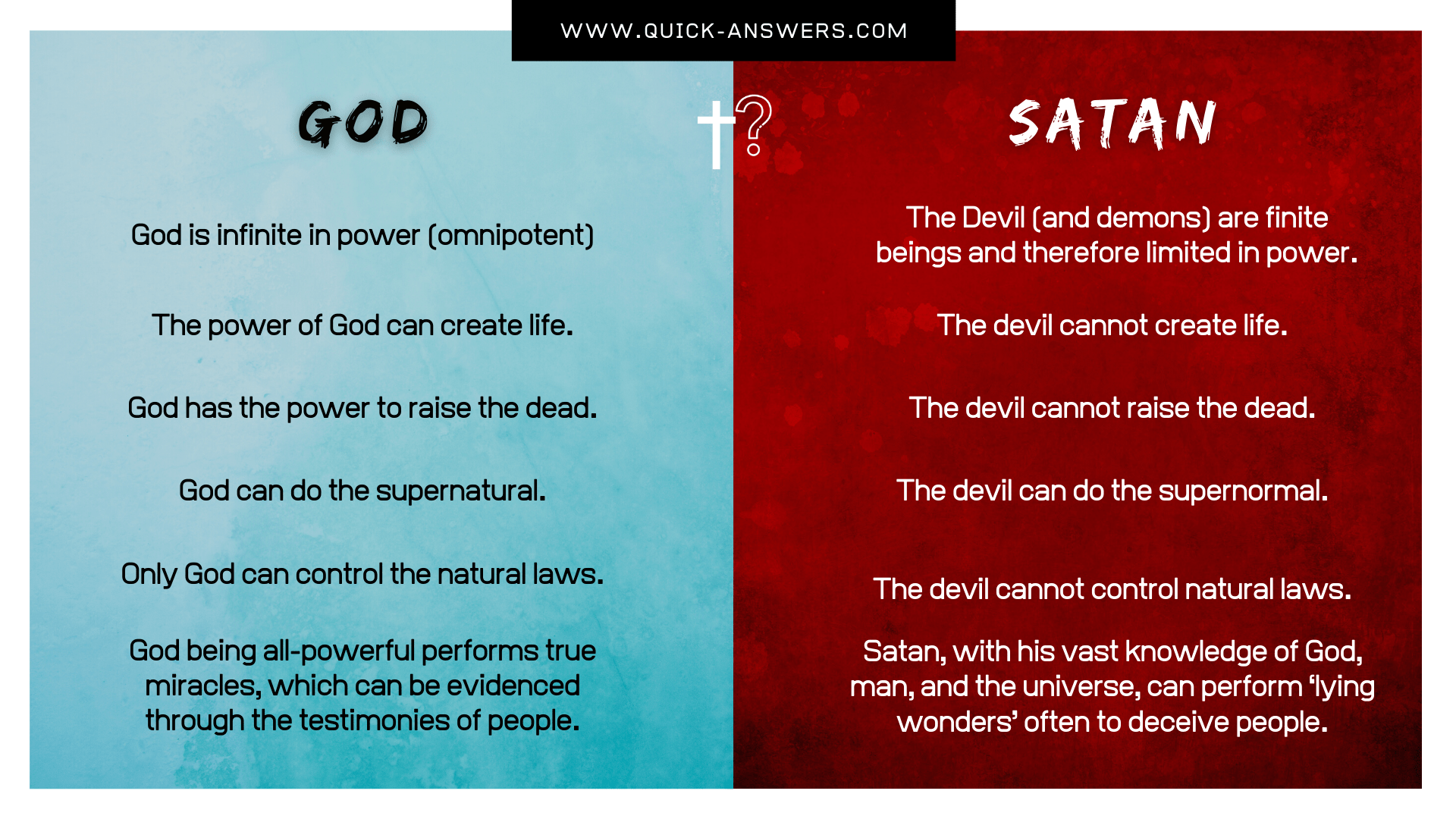
Quick Answer: They are not two powers of the same kind. God is Creator; Satan is a creature with a ceiling God set. Satan cannot create and cannot raise the dead. His signs are called lying wonders not because nothing happens, but because of the false conclusion they are staged to produce.
Preaching at Pentecost, Peter summed up the ministry of Jesus in three words.
Acts 2:22 (NKJV)
Men of Israel, hear these words: Jesus of Nazareth, a Man attested by God to you by miracles, wonders, and signs which God did through Him in your midst, as you yourselves also know—
Paul used the same three words of the coming man of sin.
2 Thessalonians 2:9 (NKJV)
The coming of the lawless one is according to the working of Satan, with all power, signs, and lying wonders,
Power, signs, wonders. Scripture does not keep one vocabulary for God’s works and a lesser one for Satan’s, and the reason is uncomfortable: from the outside, the two can look alike. That is what this question is really asking about.
God and Satan are not two powers of the same kind, one bigger than the other. The Bible never presents them as rival forces. God made everything that exists, including every angel, including the one who became Satan. Satan is a creature.
A creature has a ceiling, and God set it. Nothing was made without the Son (John 1:3), and whatever the Lord pleases He does (Psalm 135:6) — words no creature could ever be described by. Satan and his demons are real and dangerous, but dangerous the way a strong man inside a locked room is dangerous. When Satan set himself against Job, he had to ask first, and God answered him with a boundary: “Behold, all that he has is in your power; only do not lay a hand on his person” (Job 1:12). Satan went out and did every bit of the harm he had been allowed to do, and not one thing beyond it.
So what lies outside the ceiling? Two things above all. Satan cannot create. He can spoil what already exists and turn it against its Maker, but he has never once called anything out of nothing. Everything he uses, he found. And Satan cannot raise the dead. That belongs to the Author of life alone, which is why the empty tomb settles the matter — every power ranged against Christ had done its worst by Friday evening, and by Sunday morning it had held nothing.
Which brings us to miracles, and to the difference that matters most in daily life. A miracle in the biblical sense is God acting directly, above the ordinary working of the world He Himself established: the sea opening, a dead boy sitting up, water becoming wine. Only the One who set the order can act above it, and Satan has never done so.
What Satan can do is work inside that order in ways that look as though it has been broken. He can influence a mind, produce an appearance, frighten, deceive, and exploit forces we understand far less well than we imagine. That is genuine power and no Christian should treat it lightly. But it is power working within the world rather than over it, which is why Paul calls the lawless one’s signs lying wonders. Paul does not call them lying wonders because nothing happens. Something does. They are lying wonders because of what the man performing them wants you to conclude — that God is behind it, and that he therefore speaks for God. Both claims are false, and the wonder was staged to make you believe them.
That leaves the ordinary Christian with a problem. If a work of God and an imitation of one can look the same, how is anybody supposed to tell them apart? John answers it:
1 John 4:1–4 (NKJV)
Beloved, do not believe every spirit, but test the spirits, whether they are of God; because many false prophets have gone out into the world. By this you know the Spirit of God: Every spirit that confesses that Jesus Christ has come in the flesh is of God, and every spirit that does not confess that Jesus Christ has come in the flesh is not of God. And this is the spirit of the Antichrist, which you have heard was coming, and is now already in the world. You are of God, little children, and have overcome them, because He who is in you is greater than he who is in the world.
John is not talking about invisible beings here. He says plainly who he means: false prophets, men doing the talking. So the test is applied to a teacher, and John gives it in one sentence. Listen to what he says about Jesus Christ.
Does he confess that Jesus is God who came in real human flesh? Then he is from God. Does he avoid it, or explain it away, or make Jesus something less? Then he is not, however impressive the rest of him looks.
This is a test anybody can use. You may have no idea whether what you have just watched was genuine. You can always find out what a man teaches about Christ. And that is the one thing a deceiver cannot get right, because getting it right is the very thing he was sent to prevent.
Then comes the assurance. You are of God, little children, and have overcome them. The them is the false prophets John has just described. And the reason he gives for the overcoming is not that Christians have been handed authority over spirits. It is that God Himself lives in them. The Christian’s safety has never rested on his own strength in a fight; it rests on who has taken up residence.
Colossians 2:15 (NKJV)
Having disarmed principalities and powers, He made a public spectacle of them, triumphing over them in it.
Disarmed. Paul’s word assumes they were holding something, and they were. Satan’s oldest weapon against a human being is accusation, and what makes it so effective is that he never has to invent anything. He points at what you actually did, and he is not lying.
The cross did not deny the charge. It emptied it. The penalty those sins had earned fell on Christ instead, which is why Paul can ask, “Who shall bring a charge against God’s elect? It is God who justifies” (Romans 8:33). The accuser can still name what you did. He cannot make it count against you. He is loud, and he can still deceive, but since the cross he has been shouting without a weapon.
So when something impressive turns up and you cannot tell what you are looking at, do not stand there squinting at the wonder. Ask what the man teaches about Christ. That is a question you can always answer.