
Charismatic & Pentecostal movement

Charismatic & Pentecostal movement

Un-biblical Christians?

Is the Charismatic / Pentecostal movement a Christian movement? The answer is yes and no. The Charismatic movement (or any movement for that matter) can be Christian, but not necessarily biblical.

Although there are many sincere Christians in it, they are there because they don't rightly understand the Word of God and have substituted false experiences for the truth.

Charismatic / Pentecostal Movement

The Charismatic / Pentecostal movement has made huge progress in the church for two reasons: firstly, human beings are emotional creatures and often swayed with any wind of doctrine, and secondly, Christians are complacent lacking a deep understanding of their faith.

This is why the movement is dangerous because new believers are learning to live by their feelings and by having ecstatic superficial experiences rather than by faith and the truth of God's Word.

There is also an overemphasis on speaking in tongues, as well as superstitious beliefs such as special revelations and visions, which are all associated with this movement. This shift in focus has led to a decline in the emphasis on Scripture, resulting in believers who may not fully understand the gospel message in its simplest form or even care to understand the relevance.

It is unfortunate that at the heart of those movements are unconverted masses who are probably unable to even explain the gospel message in its simplest form. While they may believe that Jesus died for their sins and rose again, while they may not fully understand how He used His death to satisfy His justice and how He provided righteousness to those who believe.

Satan is Made sovereign in such movements

Essentially, these movements (charismatics and pentecostals) tend to make Satan the supreme being rather than God.

The following statements are examples of what is often said in such movements and it will make you wonder who is truly sovereign?

“God wants people to be saved and to keep them saved, but He’s can’t, because Satan is deceiving people.”

"God would like to solve the problems in the world, but the devil keeps messing things up."

Also, there are a number of circumstances in life that are constantly attributed to the devil. When you have a sick child -the devil is to blame. When you lose your job - the devil is to blame. When you fall ill - the devil is to blame. When a child goes astray - the devil is to blame.

As a result of this kind of thinking, we end up making Satan supreme over God, and living in fear all the time.

There are also believers who are always trying to bind Satan, and cast out demons. Unfortunately, in the Pentecostal church, God has become the victim and cannot do anything unless we (believers) take authority and cast out the demons ourselves.

In addition, there is a strange notion of a pervasive fear of Satan (a widespread, constant anxiety or dread of Satan's influence and power). For example, some parents cannot sleep because they are afraid that the devil will come in at night and make their babies ill, or that the devil will enter their homes, so they must pray all night to keep their houses safe and bind Satan.

There is nothing biblical about this.

According to the Bible, believers have nothing to fear from Satan.

It may sound surprising, but the enemy of God is ultimately a servant of God, and he can do only what God allows him to do. This means that the enemies boundaries, constraints, and limits are set by the sovereign God Himself.

Furthermore, the Bible teaches that through Christ, believers have been given authority over the enemy. In Luke 10:19, Jesus says, "I have given you authority to trample on snakes and scorpions and to overcome all the power of the enemy; nothing will harm you." This reinforces the truth that believers need not live in fear of Satan but rather in the assurance of God's sovereign protection.

Conclusion

In summary, the Charismatic/Pentecostal movement, with its emphasis on emotional experiences and supernatural phenomena, can lead believers away from a solid foundation in Scripture and the true gospel message.

This can result in a distorted view of spiritual authority, where Satan is seen to be as more powerful than actually he is and believers are constantly forced to live in unnecessary fear.

If you are a believer surrounded with these kinds of teachings or knows of someone in that movement who has reached this point in their understanding of God - it may be time to consider their options.
Dominion Theology

Dominion theology

Kingdom Now?

Dominion Theology is the belief that the church is destined to exercise dominion over the world's social, cultural, and political systems.

The basic premise of this belief is that Satan gained dominion over the earth when Adam sinned in the Garden of Eden, and now it is the church's mission to regain dominion from Satan so that Christ can return to rule on earth.

Consequently, followers of this theology are envisioned to establish the Kingdom of God on earth via taking control of governmental and financial empires and setting God's laws in force over them.

This concept of taking dominion over the world may sound appealing, but it ultimately misses the mark when it comes to understanding the church's true mission.

Dominion Theology misinterprets the nature of Christ's kingdom, shifting the church’s focus from spreading the gospel to a pursuit of political and social power.

It teaches that the church's role is to conquer earthly systems so that Christ can return, which is not supported by Scripture. Nowhere does the Bible suggest that Jesus’ return depends on our control over secular realms; instead, it calls us to be salt and light, influencing the world through faith and love, not by seizing power.

In the chapters that follow, we’ll examine the fundamental issues with Dominion Theology. We’ll look at how this approach distorts the gospel, placing emphasis on human authority over God’s sovereignty and redirecting the mission of the church toward earthly goals.

By exploring these flaws, we’ll see how the church is truly called to embody God’s kingdom values—through a life of humble faith and service, not by overstepping into roles that God never intended for us.

Fundamental problems of the dominion theology

  • In dominion theology, the church's "hope" is to establish an earthly kingdom rather than wait for Christ's second return and His new kingdom. As a result, the great commission (of evangelism) has thus been re-defined as a church-wide mission to regain control of the world, institution by institution and nation by nation. Those who believe this are ignorant of what the scriptures and the early apostles believed. They hoped for Christ's imminent return and until then involved themselves to fulfill the great commission through the power of the Holy Spirit.

  • Leaders of Dominion Theology often use allegorical, symbolic, spiritualizing interpretations of scripture, which can lead to false interpretations and further deception. The fundamental of literal interpretation of the Bible is often lost in favor or a more mystical outcome.

  • Its adherents also tend to assume that they possess the authority and power to command God to move on their behalf, in turn taking the glory and honor that belong to Christ.

  • It wrongly encourages the development of a “spiritual elite / group”, which includes prophets and teachers who claim to possess special keys and access to the throne of God and the authority to attain dominion. This results in its followers putting their trust in faith and human leaders rather than in God and His word. Additionally, it fosters unchristian attitudes of arrogance and pride amongst the leaders.

  • At church services, biblical doctrine has been replaced by the prophetic, spiritual gifts, and the supernatural, which are seen as normative and are used as signs that the church is actively reclaiming authority and expanding God’s kingdom on earth.

  • Dominion theology also raises false expectations and ignores the reality of living in this present evil world.

  • There is also an increasing emphasis on using specific formulas, and strategies for spiritual warfare or tactics to defeat satan instead of living by the basic principles of humility, biblical truth, and faith in God.

In conclusion, Dominion Theology distorts the true mission of the church. By redefining the Great Commission as a mandate to take control of worldly institutions, it shifts the focus away from evangelism and discipleship, placing it instead on a misguided pursuit of earthly power.

This teaching draws many into relying on human authority, special revelations, and supernatural displays, all while replacing humble, Christ-centered faith with a focus on self-elevation and spiritual elitism.

The result is a movement that encourages trust in leaders and “prophets” over God’s Word and fosters a mindset of pride rather than true humility.

In the next section, we’ll look at why biblically we cannot accept this theology, examining Scripture’s clear teachings about the church’s real mission and our hope in Christ’s return, which alone will usher in His eternal kingdom.

Biblically we cannot accept dominion theology for the following reasons; 

  • When the Bible speaks about the rapture, it does not imply that believers are to achieve dominion or establish any sort of earthly triumph before Christ’s return. It simply states that we are to trust and hope for Christ's return. (1 Thessalonians 4:13-18; Titus 2:13).

  • In the Bible, it is clearly taught that Jesus Christ will establish a 1000-year earthly kingdom. There is, however, no scripture backing for dominion theology that the Christ will not come until the church first establishes a kingdom on earth (this is an unsupported claim).

  • It does not uphold the uniqueness of the New Covenant, which replaces the Old Covenant (Hebrews 8:6-13). Instead, it emphasizes the pursuit of establishing a different earthly kingdom, diverting focus from the spiritual nature of Christ's kingdom and His completed work.

  • The emphasis is wrongly placed on human capabilities and techniques. There is no emphasis given to the sinfulness of human nature (Romans 3:10-12), and it also contradicts biblical teachings on humility, patience, faith in God, the finished work of Calvary, and the superiority of Christ (Romans 12:1-3, I Corinthians 2:1-5; 2 Corinthians 4:7; Colossians 2:1-23).

  • The Bible reveals we are engaged in spiritual warfare, but it does not prescribe the same techniques the Dominion Theology illustrates. Although the Bible teaches that we have victory over the devil, it emphasizes to place our faith in God's sovereignty and the adequacy of the Cross, not on human authority (Acts 3:14-16).

In conclusion, we are not called to take dominion over the institutions of this world. We are not called to take dominion over demons and over the devil. We are called to put on our spiritual armor (Ephesians 6:10-18), resist that demonic world (James 4:7; 1 Peter 5:8-9), and rely on the power of God who takes care of them (Romans 16:20).

Little god’s Doctine

Little God's Doctrine

Are we all gods?

Genesis 1:26 (NKJV)

Then God said, “Let Us make man in Our image, according to Our likeness; let them have dominion over the fish of the sea, over the birds of the air, and over the cattle, over all the earth and over every creeping thing that creeps on the earth.”

Many have interpreted the phrase "created in God's image" to mean that we are in essence little gods? But this is simply not true, and it is an absurd presumption to consider ourselves in the same class as God.

The message of Genesis is that we are made in God's image/likeness, i.e. we have a rational, moral nature, and have dominion over creation.

Being made in God’s image means we share certain aspects of His nature, such as moral reasoning and authority over creation, yet our reflection of Him is partial and limited

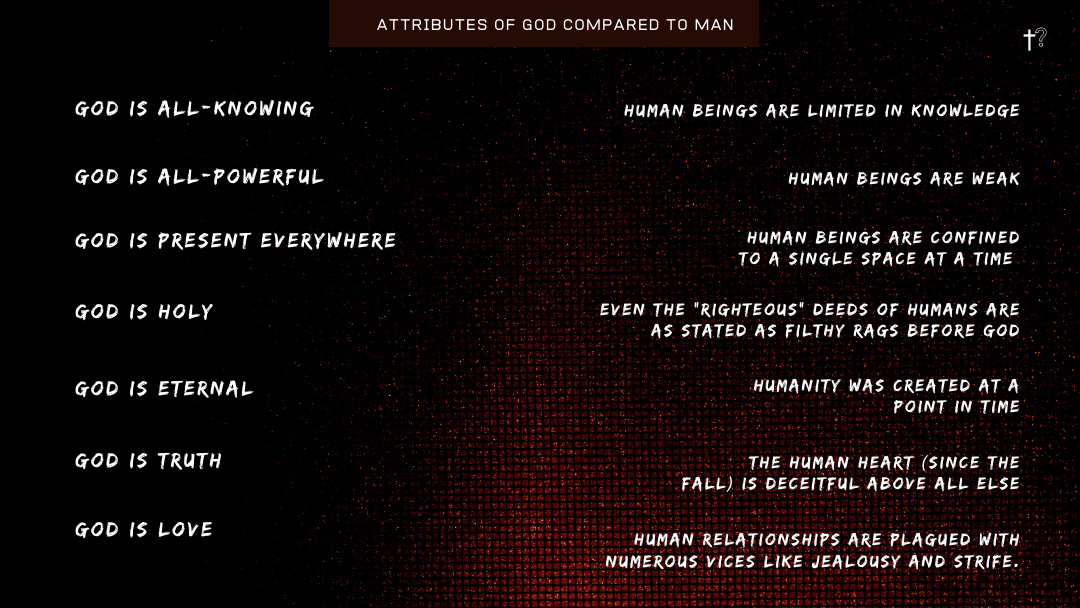
If it were true that human beings are “little gods,” then one would expect them to display qualities similar to those known to be true of God.

When the Bible speaks of the attributes of mankind, it states that we ‘fall short of the glory of God’.

Romans 3:23 (NKJV)

for all have sinned and fall short of the glory of God,

In addition, let’s look at the following attributes of God as compared to man.

God vs man

What about Jesus' statement Where He calls us gods?

John 10:34 (NKJV)

Jesus answered them, “Is it not written in your law, ‘I said, “You are gods” ’?

As with Psalm 82:6, John 10:34 is often read out of context to imply that humans are divine or can achieve god-like status. This interpretation misses Jesus' argumentative intent in the dialogue.

Psalm 82:6 criticizes leaders, such as those of nations or cities, for their unjust judgments and failure to protect the vulnerable, like the weak and fatherless.

In biblical times, specifically in Exodus, when individuals sought justice or resolution from their rulers, it was like seeking help from God. This is because these rulers were seen as representatives of God's authority, a concept also echoed in Romans 13. Romans 13 emphasizes that governmental power is derived from God, positioning rulers as God's earthly representatives.

If we look at the context of John 10, Jesus uses the metaphor of a shepherd to emphasize His unique relationship with His sheep (believers). As the chapter progresses, Jesus claims unity with the Father, indicating His divine nature: "I and the Father are one" (John 10:30). This claim incited a strong reaction from the Jewish leaders, who were ready to stone him for blasphemy.

In response (John 10:34), Jesus references Psalm 82 to challenge the inconsistency of the Jewish leaders: if human rulers can be called "gods" in their authoritative roles without blaspheming, how much more appropriate is it for Jesus, given His works and mission, to claim His unique sonship and unity with the Father?

According to Jesus, if mere men can be called gods (whether that be human rulers/judges or heavenly beings) because they are judges, how much more should one who claims to be the Son of God, who has come directly from the Father, be recognized for His divine authority and unity with God? Jesus isn’t suggesting that humans possess divinity; rather, He’s exposing the inconsistency in the leaders’ accusations while affirming His unique identity as the Son of God.

By referencing Psalm 82, Jesus highlights that if human judges can be called “gods” in their limited roles, then His own claim to Sonship—backed by the works He performs through the Father’s authority—is entirely justified. This wasn’t an attempt to elevate humanity to divinity but rather to reveal His rightful place as one truly sent by God, bearing His authority in a way that no mere man could.

Jesus’ response leaves no room for misinterpretation: while we are made in God’s image, only Christ is one with the Father in essence and authority. His words remind us that, though we may bear God’s image, we are not gods; instead, we are called to recognize and honor the One who is.

Moralistic preaching

Moralistic preaching

Danger In teaching that salvation can be earned by keeping high moral standards.

Nowadays, there is a type of preaching that teaches only “biblical" commands and nothing else. Congregations under this type of teaching are encouraged to simply be a good person and God will love you.

Under such situations when doubtful believers approach their teachers with questions about their faith, they are often asked to test their faith by the following questions:

  • What have you done to earn God’s favor or please Him?
  • Have you prayed enough?
  • Have you tithed enough?
  • Have you laid hands on anybody?
  • Have you prayed in Tongues?

What ultimately happens is that church becomes less about growing in a relationship with Christ and more about fulfilling a checklist of religious tasks, turning it into a kind of Christian self-improvement program.

The danger in preaching a message that says, “Be a good person, and God will love you for that” is that it shifts the focus from grace to self-effort. This message is not only unbiblical, but it contradicts the core of the gospel, which teaches that salvation is a gift, not something earned by human effort. When believers are taught that they must achieve goodness to earn God’s favor, they’re given an impossible goal, which can lead to despair, as they continually fall short, or to pride, as they become overly focused on their own good deeds. In both cases, it obscures the true Christian message of salvation by grace through faith in Christ. Preaching a morality-based message alone can encourage self-righteousness rather than humility and gratitude for what God has done.

Let’s look at an incident recorded in the scriptures where Jesus counsels the Rich Young Ruler.

Matthew 19:16-22 (NKJV)

Now behold, one came and said to Him, “Good Teacher, what good thing shall I do that I may have eternal life?”

So He said to him, “Why do you call Me good? No one is good but One, that is, God. But if you want to enter into life, keep the commandments.”

He said to Him, “Which ones?” Jesus said, “‘You shall not murder,’ ‘You shall not commit adultery,’ ‘You shall not steal,’ ‘You shall not bear false witness,’

‘Honor your father and your mother,’ and, ‘You shall love your neighbor as yourself.’

The young man said to Him, “All these things I have kept from my youth. What do I still lack?”

Jesus said to him, “If you want to be perfect, go, sell what you have and give to the poor, and you will have treasure in heaven; and come, follow Me.”

But when the young man heard that saying, he went away sorrowful, for he had great possessions.

In verse 16, the Rich Young ruler starts by asking "what must I do" to attain eternal life. It has already become about his own performance. In response, Jesus tells the man that only God is good, and that he must keep God's commandments, to which the man replies that he already does.

So what actually happened here?

Jesus points to God as “only good” and two seconds later the man says “me too” which evidenced his sin of pride and self-idolatry. Seeing the man's sin and motives, Jesus tells the rich man to sell everything, and the man simply walks away.

In this encounter, Jesus exposes the heart of the Rich Young Ruler, revealing that his real issue isn’t a lack of moral goodness, but rather his reliance on his own achievements. By asking him to sell everything, Jesus shows that the man’s wealth and self-righteousness have become idols, standing between him and a true relationship with God. When the man walks away sorrowful, it becomes clear that he cannot save himself through his own good works.

The lesson here is that salvation cannot be earned by simply being a “good person.” Trying to win God’s favor through a checklist of moral deeds not only burdens people with an impossible goal but distracts them from the true message of the gospel—that salvation is a free gift for those who place their faith in Christ’s finished work. When we reduce Christianity to a set of rules, we risk turning church into a Christian self-help program rather than a place to grow in a relationship with Christ. The gospel calls us to surrender, not strive; to receive grace, not earn it. True obedience flows from a heart transformed by God’s love, not from an effort to secure it.

Using the law in evangelism

Using the law in evangelism

The law is our most effective tool in evangelism. If we fail to use it, we will have to resort to telling people that their lives are a mess and to fix it they “must” follow Christ.

Some people use incorrect statements in evangelism like:

  • "You will never find peace without Jesus Christ."
  • "There is a piece missing in your heart that only God can fill." 
  • "True peace, happiness and fulfillment can only come from being a Christian."

Some Christians look at seemingly "happy people" who are having a good time mocking Christians and blaspheming or joking about Christ, and they say, "these people don't know true lasting happiness; so we should maybe cut their tires and bring them to Christ or wait till their house burns down so we can share with them the happiness we have in Jesus. 

These are all silly attitudes/means of evangelism that aren't biblical, and neither do they work. What we need to do is show non-believers the law and ask them to measure themselves against it.

People don't need happiness; people need righteousness and freedom from the guilt of sin. 

The heart of evangelism lies here. 

The law and Gospel

the difference between the law and gospel

The law =DO, the Gospel =DONE.

The Gospel is not what would Jesus do and now go and do that. The Gospel is what has Jesus DONE - now believe that.

The GOSPEL = Relationship

The LAW = Obedience

This simple pattern of RELATIONSHIP first before OBEDIENCE is also a key trend in the Bible.

We do not have a relationship with Him because we obey, we obey because He has made a relationship with us.

For example lets look at Exodus 20 vs 1-3

Versus 1-2 show us what God has done (relationship) for us:

And God spoke all these words, saying:“I am the Lord your God, who brought you out of the land of Egypt, out of the house of bondage.

Verse 3 shows us what He requires us to do (law) in response:

“You shall have no other gods before Me.

God didn’t say you should obey me, and then I will let you out and free you. He says, I have redeemed you, and here is a safe path for you to walk in.

This order is not just in the Old Testament, but the same pattern is followed in the New Testament epistles as well.

In general, the first half of the Epistles of Paul / John / Peter / Romans / 1 Peter says “Here is how God has saved you” “ what God has done for us.” The last half of the Epistles say “Here is what you should do in response.”

Done  Romans Chapter 1-11 ---- Do  Chapter 12-16

Done  Ephesians Chapter 1-3 --- Do  Chapter 4-6

Done  1 Peter Chapter ---- Do  1 Chapter 2-5

Done  Galatians Chapter 1-4 ---- Do  Chapter 5-6

Done   Colossians Chapter 1-2 ---- Do  Chapter 3-4

The Moral Law of God can be understood through an interesting analogy.

Using the metaphor of a train, the moral law represents the railroad, and the Gospel is the fuel that powers the train's engine. To tell a Christian / non-believer, "Here is your track, follow it." makes no sense because ultimately they  (like a train) need fuel (the gospel) to get moving.

This is also true of many Christians today who are like trains without fuel or an engine, and therefore are often stagnant in their Christian walk.

The law alone cannot save; it must be accompanied by the saving message of Christ crucified. The purpose of the law is to bring us to a knowledge of sins.

It can be used as a barrier to restrain sin and control our behavior. The law acts as a tutor, leading us to Christ, who is the answer to our need for salvation and righteousness. By exposing our sin and showing us God’s perfect standard, the law reveals our inability to achieve that standard on our own.

Christ fulfills the law's demands through His life, death, and resurrection, offering forgiveness and righteousness to all who believe, thus meeting the very need the law highlights.

Galatians 3:24 (NKJV)

Therefore the law was our tutor to bring us to Christ, that we might be justified by faith.

Galatians 3:21 (NKJV)

Is the law then against the promises of God? Certainly not! For if there had been a law given which could have given life, truly righteousness would have been by the law.