
What does it mean that Jesus is the passover lamb?
Jesus is the true Passover Lamb, whose blood saves not from one night’s judgment but for eternity. John called Him ‘the Lamb of God who takes away the sin of the world’ (John 1:29), and Paul says plainly, ‘Christ, our Passover, was sacrificed for us’ (1 Corinthians 5:7). He fulfilled every detail — a spotless male, no bone broken (Exodus 12:46) — and as the blood on the doorframe turned away death, His blood must be personally applied to you.
No event in the Old Testament foreshadows the cross more clearly than the Passover.
The Passover begins in Egypt, where God's people had lived under brutal slavery for generations, forced into hard labour under Pharaoh. Through the prophet Moses, God confronted Pharaoh again and again, sending plague after plague — each a direct blow against the false gods of Egypt (Exodus 12:12) — and demanding that His people be released. Pharaoh refused every time. And so, as His final act of judgement, God declared that at midnight every firstborn son in the land of Egypt would die.
But for the Israelite families living in that same land, God provided a way of escape. Each household was to take a spotless lamb, kill it, and mark the doorframe of their home with its blood. That night the LORD passed through the land; the destroyer struck every house without the mark and passed over every house that carried the blood (Exodus 12:23). By morning, while Egypt mourned, the people of Israel walked out free.
The meaning was unmistakable. A lamb died so that people could live. The judgement did not skip the house — it fell on the lamb instead. A substitute had absorbed what would otherwise have fallen on them.
God commanded His people to remember this event on an annual basis through the Passover feast — a meal where every generation shared the same bread, retold the same story, and passed on the same memory to their children: we were slaves, God provided a lamb, and the blood on the door kept death away. It was never merely a history lesson. Year after year, Israel was reminded that their freedom had been bought through the blood of a substitute.
Centuries later, it was no accident that Jesus was crucified at the time of Passover. God had ordered every detail of redemptive history so that the true Lamb would die at the very festival that had been pointing to Him all along.
Before Jesus' public ministry had even begun, John the Baptist saw Him approaching and cried out, “Behold! The Lamb of God who takes away the sin of the world!” (John 1:29). It was a startling thing to say. To call a man “the Lamb of God” was to gather up the entire sacrificial system — every lamb Israel had ever offered — and lay it on one person. John was claiming that this was the One those centuries of sacrifices had been pointing to all along.
The Apostle Paul made the connection explicit: “Christ, our Passover, was sacrificed for us” (1 Corinthians 5:7). Once you see Jesus as the Passover Lamb, two things become staggering at once — how far He surpasses the original, and how precisely He fulfils it.
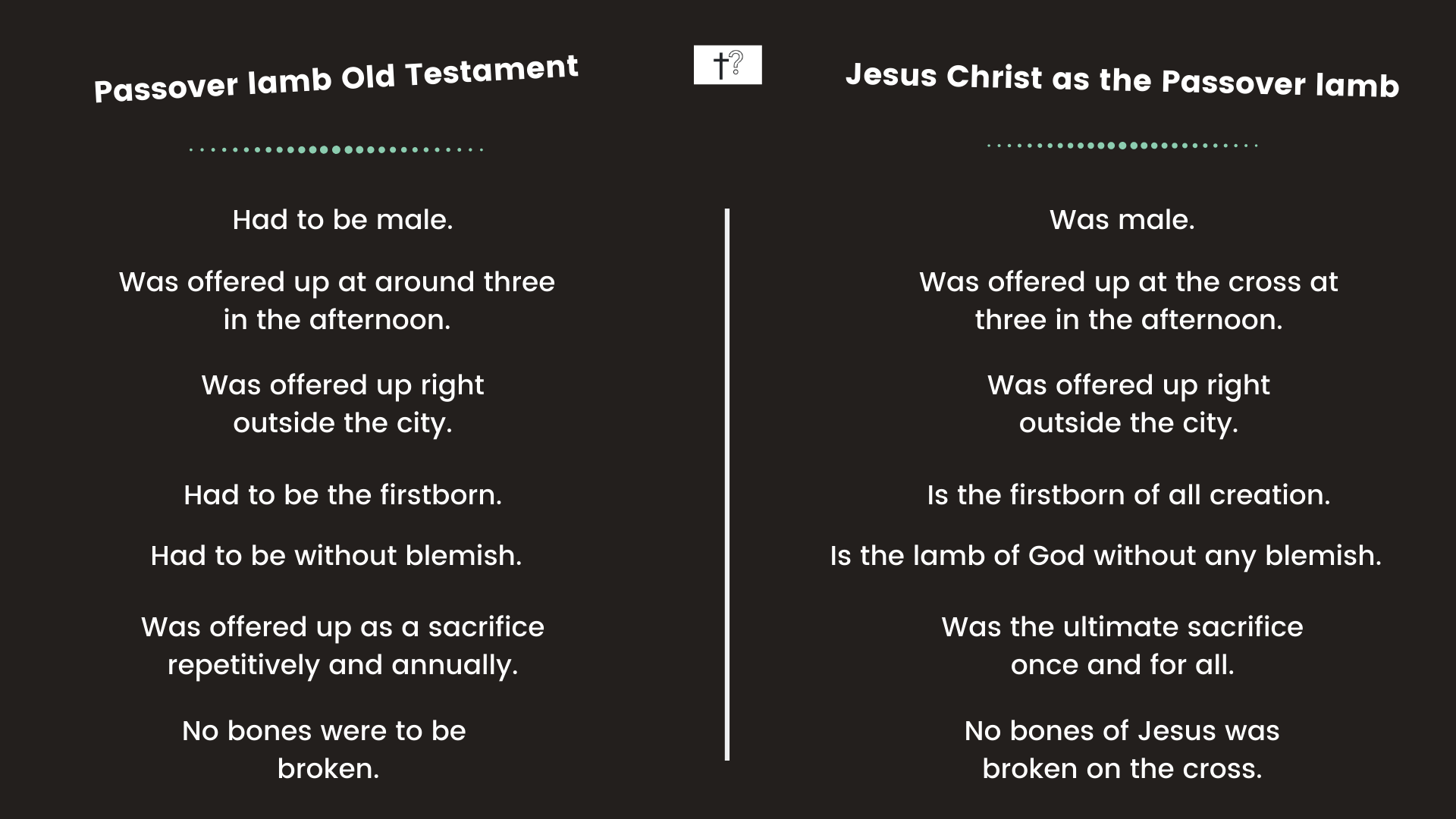
Consider first how He surpasses it. The Passover lamb spared a household for a single night; the blood of Jesus saves people from every tribe and nation for eternity. The lamb's blood protected Israel from one act of judgement; Christ's blood delivers us from eternal judgement. The lamb freed Israel from Pharaoh's grip; Christ frees us from the slavery of sin and death itself.
Now consider how precisely He fulfils it. The lamb had to be male — Jesus was male. It had to be without blemish — Jesus was the sinless Lamb of God (Exodus 12:5). Not one of its bones was to be broken — and when Jesus died, the soldiers found Him already dead and broke none of His bones, exactly as Scripture had said (Exodus 12:46; John 19:36). And by Jesus' day the lambs were slain in the mid-afternoon, around three o'clock — the very hour at which Jesus gave up His spirit (Mark 15:34–37). Year after year, lamb after lamb, Israel had been rehearsing the details of a sacrifice whose true fulfilment lay centuries ahead.
There is one last thing the Passover teaches, and it is personal. In Egypt it was not enough that the lamb was killed; the blood had to be applied — brushed onto the doorframe of each home. A lamb slain in the yard saved no one. Only the blood on the door turned death away (Exodus 12:13). So it is with Christ. That He died as the true Passover Lamb is the heart of the gospel — but the question it presses on every reader is whether His blood marks your door. The Lamb has been slain; what remains is to take shelter under the blood.