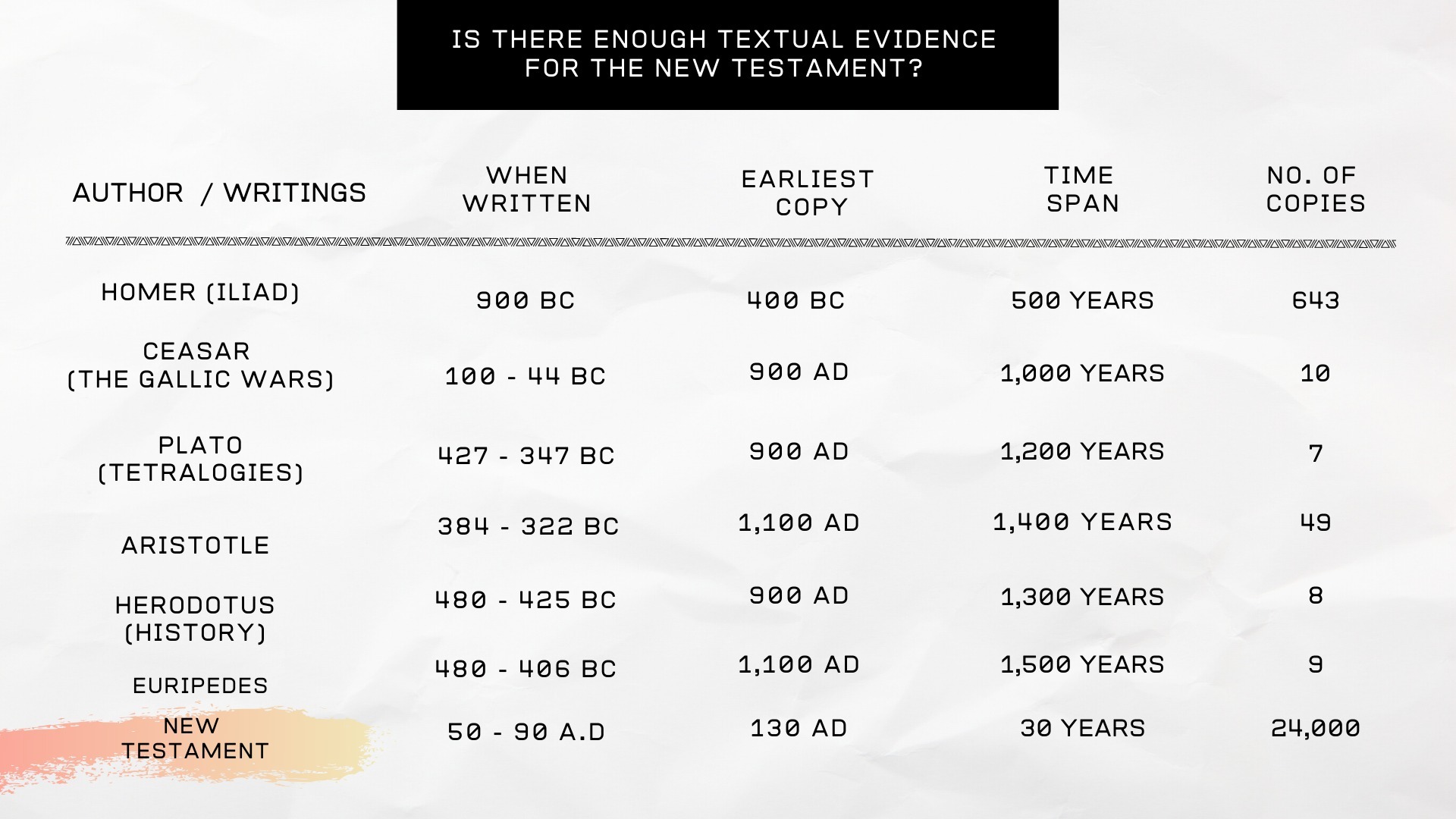
Is there enough textual evidence for the New Testament?
More than for any other work of antiquity — by a wide margin. Close to 6,000 Greek manuscripts survive, over 20,000 counting other languages. The oldest fragment is within a century of John's pen. By comparison, Homer survives in ~1,750 copies, the earliest five centuries after him.
We do not possess the original of a single document from the ancient world. Not Caesar's, not Plato's, not Homer's — and not Paul's. Every ancient text reaches us through copies. So when historians ask about the textual evidence for an ancient work, they are asking two questions about those copies. How many survive? And how close is the oldest survivor to the day the work was written? The more copies there are, the more places to check the wording against. The shorter the gap, the less room for the text to drift. Measured by the standard historians already use, nothing else from antiquity comes near the New Testament.
Take the gap first. The New Testament was written inside the lifetime of the men who walked with Jesus. Most of it was circulating before AD 70, and the last of it was finished before the century closed. That matters because the people who could have contradicted it were still alive and still in the same towns. Luke says as much at the opening of his Gospel, and he is careful to tell his reader exactly where his material came from.
Luke 1:1–4 (NKJV)
Inasmuch as many have taken in hand to set in order a narrative of those things which have been fulfilled among us, just as those who from the beginning were eyewitnesses and ministers of the word delivered them to us, it seemed good to me also, having had perfect understanding of all things from the very first, to write to you an orderly account, most excellent Theophilus, that you may know the certainty of those things in which you were instructed.
Luke is describing research. He was not there himself; he went to the men who had been there from the beginning, checked what they told him, set it in order, and then named the man he was writing for. Theophilus could go and ask. Documents written that early, among people in a position to check them, are not how legends begin. A legend needs time — long enough for everyone who was there to be gone.
The other end of the gap is the oldest surviving copy. The oldest surviving piece of the New Testament is a scrap of John's Gospel called the John Rylands Papyrus, catalogued as P52. It is about the size of a bank card and carries a few verses of John 18. Scholars place it in the first half of the second century. Bart Ehrman, an agnostic critic with no interest in helping the Christian case, dates it to around AD 125 to 130, give or take twenty-five years. Take the very latest end of that range and the distance between John's pen and our oldest surviving copy is still under a century. Substantial portions of the New Testament survive from around AD 200, and complete copies from the fourth century.
The quantity is on another scale altogether. Close to six thousand Greek manuscripts of the New Testament have been catalogued. That number includes the lectionaries — service books containing the Scripture readings arranged for the church's yearly round of worship, which carry the text in a second and independent form. Add the Latin copies, more than ten thousand of them, and thousands more in Syriac, Coptic, Armenian, Slavonic, Georgian and Ethiopic, and the total passes twenty thousand.
Set that against the rest of ancient literature. The nearest rival is Homer's Iliad, which survives in around 1,750 copies — about a third of what we hold in Greek for the New Testament — and the earliest of those copies was made some five centuries after Homer. Nothing else comes close on either count. Caesar, Plato and Herodotus survive in two or three hundred copies at most, and for each of them the oldest copy in existence was written roughly a thousand years after the author died. No historian treats those men as unknowable. Their books are taught in every university in the world, and the New Testament rests on more copies than all of them put together.
There is one more body of evidence, and it does not depend on the New Testament manuscripts at all. The Christian writers of the second, third and fourth centuries quoted Scripture constantly in their sermons, letters and commentaries. Bruce Metzger, whose handbook on the New Testament text has trained generations of scholars, judged that if every manuscript were destroyed, those quotations alone would be enough to reconstruct practically the whole of the New Testament.
So the question answers itself the moment the standard is applied evenly. A man is free to decide that the New Testament is false. He is not free to claim that we cannot know what it said, because that objection, pressed consistently, takes the whole of the ancient world down with it — and no historian is willing to pay that price. The words have reached us. What remains is not a question about the manuscripts but about the God who speaks in them.