
What does it mean to fear God?

What does it mean to fear God?

Last Updated

Jul 23, 2026

Reading Time 'Minutes'

Word Count

There is a moment in Mark's Gospel where a group of men are more frightened after the danger passes than they were while it lasted. The disciples are crossing the lake at night when a storm comes down on them, and the boat begins to fill. They wake Jesus, convinced they are about to drown. He speaks to the wind and the sea, and the storm stops — not gradually, the way weather usually clears, but at once. The water goes flat. And in that silence, with nothing left to threaten them, Mark records this:

Mark 4:41 (NKJV)

And they feared exceedingly, and said to one another, “Who can this be, that even the wind and the sea obey Him!”

Notice the drastic change. The first fear was fear of drowning — the ordinary fear of something that can hurt you. That fear left when the storm did. What replaced it was greater, and it had no danger attached to it at all. It was the fear of the One sitting in the boat with them. They had just discovered whom they had been travelling with, and the discovery frightened them more than the sea had.

That is where the biblical phrase “the fear of the Lord” begins. It is not anxiety, and it is not the fear of harm. It is what happens in a creature who suddenly grasps what he is standing in front of. When John saw the risen Christ in glory, this is what became of him:

Revelation 1:17 (NKJV)

And when I saw Him, I fell at His feet as dead. But He laid His right hand on me, saying to me, “Do not be afraid; I am the First and the Last.”

John's collapse was not a misunderstanding that needed correcting. He was seeing accurately for the first time, and the sight flattened him. Yet the response of Christ was not to confirm his terror but to put a hand on him and tell him not to be afraid. The fear was right. And the hand was what changed it.

This is why the Bible speaks about fearing God in two very different ways, and why they must not be confused. There is a fear that expects punishment — the fear of a guilty man before a judge who has every right to condemn him.

That fear is not irrational. Outside of Christ it is the only sane response to a holy God, and the Bible never tells the unrepentant that they have nothing to worry about. But it is precisely this fear that the gospel removes:

1 John 4:18 (NKJV)

There is no fear in love; but perfect love casts out fear, because fear involves torment. But he who fears has not been made perfect in love.

John is not saying that Christians stop fearing God. He is talking about one particular fear — the fear of being punished. That is what his word torment points to. And that fear is gone for the Christian, because Christ has already taken the punishment in his place.

What remains is a different fear altogether, and remarkably, Scripture says it is produced by forgiveness rather than removed by it:

Psalm 130:4 (NKJV)

But there is forgiveness with You, that You may be feared.

That line is worth pausing over. We would expect forgiveness to end fear. A judge pardons a guilty man, and the man stops being afraid of him — the danger is over. The psalmist says the opposite. Forgiveness is the reason God is feared.

Here is why. Being forgiven shows you two things at once: how serious your sin was, and what it cost God to forgive it. A man let off lightly has forgotten it by evening. A man pardoned at enormous cost never gets over it. He does not walk away from God casually. He walks away in awe of Him.

Being loved by God does not make Him smaller in our eyes. It is how we find out how great He is.

That is the fear a child has for a good father — not the cringing of a servant who expects the whip, but the unwillingness to grieve someone whose love is the safest thing in his world. He is not afraid of being thrown out of the house. He is afraid of offending the one who brought him into it. Take away the love and you are left with mere dread; take away the fear and you are left with a casualness that no one who has actually seen God has ever felt.

This does not change when a person becomes a Christian. Hebrews was written to believers who already stood secure in God's grace, and it still tells them:

Hebrews 12:28-29 (NKJV)

Therefore, since we are receiving a kingdom which cannot be shaken, let us have grace, by which we may serve God acceptably with reverence and godly fear. For our God is a consuming fire.

Grace and godly fear sit in the same sentence. God is still a consuming fire. Grace does not put the fire out — it brings us near enough to feel the heat, and calls us sons while we stand there.

Another famous verse we should look at with regard to the fear of the Lord is found in the book of Proverbs:

Proverbs 9:10 (NKJV)

The fear of the LORD is the beginning of wisdom, and the knowledge of the Holy One is understanding.

The verse makes a claim: fear God, and you will become wise. Here is why that is true.

Wisdom is knowing how to live. But you cannot know how to live until you know what you are — who made you, what you are here for, what happens when you die. Leave God out and you have left all of that out. You are guessing about the things that matter most, however clever you may be about everything else.

So wisdom does not start with a subject. It starts with a Person — the Holy One. You do not become wise by learning more. You become wise by coming to know God.

That is why the Bible can call a brilliant man a fool. It is not measuring how much he knows. It is measuring what he has left out.

Ecclesiastes spends twelve chapters trying every route to a meaningful life — pleasure, work, money, learning — and finds each one empty. This is where it ends:

Ecclesiastes 12:13 (NKJV)

Let us hear the conclusion of the whole matter: Fear God and keep His commandments, for this is man's all.

Notice what the verse joins together: fear God, and keep His commandments. The two go with each other. Fear of God is not a feeling you have in church and leave behind in the car park. It shows up in how you spend your money, how you speak about people who are not in the room, and what you do when you are certain no one will ever find out. Someone who knows God is watching behaves the same in an empty room as in a full one.

So what does it mean to fear God? It means seeing God as He really is, and living as though you have seen Him.

And you cannot work it up by trying. Look at the men in this chapter. The disciples did not decide to be afraid in the boat; they saw what Jesus did, and the fear came. John did not choose to fall at Christ's feet; he saw Him, and his legs went from under him. Fear follows sight. So the prayer to pray is not “make me more reverent.” It is “show me who You are.”

The fear of the Lord is the beginning of knowledge, But fools despise wisdom and instruction.

Proverbs 1:7
Why does God allow sin to exist?

Why does God allow sin to exist?

Last Updated

Jul 23, 2026

Reading Time 'Minutes'

Word Count

Behind everything God does stands a single purpose: His own glory. That is the short answer to why He allows sin. Not that God takes pleasure in evil, and not that His glory somehow depends on it, but that within His sovereign plan He has chosen to let sin run its course for a season, so that His response to it might display who He is in a way the universe would otherwise never have seen.

God did not permit evil to fill a gap in His happiness or to make Himself more glorious than He already was. Whatever purpose sin serves, it adds nothing to God. He was complete without it.

What sin does is make the perfections of God visible to His creatures — perfections that, by their very nature, could only be shown in a world where something had gone wrong.

Consider mercy. Mercy is kindness shown to the guilty; where there is no guilt, there is nothing for mercy to answer. The same is true of grace toward the undeserving, of forgiveness toward the offender, of patience toward the rebel, and of justice against the wrongdoer.

A universe without sin would be a universe that never saw God forgive, never saw Him show mercy to those who had earned wrath, never watched grace triumph over judgment. In permitting sin, God opened the stage on which the deepest riches of His character could be shown. Paul says exactly this: God saves sinners “that in the ages to come He might show the exceeding riches of His grace in His kindness toward us in Christ Jesus” (Ephesians 2:7).

This is why the existence of sin, terrible as it is, sits inside God's purpose rather than outside His control. Allowing sin is not the same as approving it — God never endorses the evil He permits.

He lets sin exist not because He is indifferent to it, but because His triumph over it will reveal Him more fully than an untested innocence ever could. And that revelation is not only for us. Paul tells us that what God is doing is watched from heaven itself: God's purpose is “that now the manifold wisdom of God might be made known by the church to the principalities and powers in the heavenly places” (Ephesians 3:10). The angels themselves learn something of God by watching how He redeems a fallen world.

So sin is permitted, but it is never pointless, and it is never permanent. It serves, for a time, to show the watching universe attributes of God that only a rescued world could reveal — and then it is done away with.

THE FOOL SAYS IN HIS HEART, 'THERE IS NO GOD.'

Pslam 14:1

What is the difference between God’s Sovereignty and God’s providence?

What is the difference between God's Sovereignty and God's providence?

Last Updated

Jul 23, 2026

Reading Time 'Minutes'

Word Count

In Christian theology, the concepts of God's sovereignty and providence are often discussed in tandem. While they are closely related, understanding their nuances is key to grasping the deeper aspects of God and how He operates in the world.

God's sovereignty refers to His ultimate authority and power over all creation. It signifies His right and ability to govern the universe according to His divine will. On the other hand, God's providence is the means by which He exercises this sovereignty — it's how He orchestrates the details of the universe to fulfill His purposes.

As we fully understand the nature of God from the scriptures, we learn that He not only determines what is to be done, but He also acts to accomplish His ultimate will.

This is important to understand because God isn't inactive in the world; He is very active in our world today and is constantly working to ensure that His purposes are fulfilled and accomplished.

In the life of a Christian, God acts in several ways. Through the Holy Spirit He spiritually regenerates, illuminates the word of God, and empowers us to do the work of God. In the lives of unbelievers, He does a spiritual work by bringing them to a place of repentance and salvation. And once they are born again, the Holy Spirit moves them in the process of sanctification (toward Christlikeness), leading and guiding them in a continuous process of spiritual growth.

Apart from this spiritual work, He also works in the physical dimension of life. Historically, God is involved in our physical world in two ways. One is through providence, and the other is through miracles.

Let's first examine the difference between the two. A miracle is when God acts by suspending the natural laws He created — like raising someone from the dead, walking on water, a floating axe, or the sun standing still.

This is also seen in the life of Jesus, where He performed miracles that suspended the natural laws — for example, feeding the five thousand, stopping a storm, and healing people. These miraculous powers transcend the natural law and order of nature.

However, it should be noted that these miracles tend to cluster: a few seasons of the Old Testament (Moses, Elijah and Elisha), the three-year ministry of Jesus, and the apostolic age of the early church. They are concentrated around moments of fresh revelation — God authenticating new revelation with miraculous signs. The Reformed tradition has historically held a position called cessationism on the foundational sign-gifts: these gifts ceased with the apostles. God can still act miraculously today and sometimes does, but this is not the normal mode of His working.

Now apart from the miraculous suspension of the natural law, God works in another way in the physical and temporal world — through providence. Providence is how God works out His will without suspending or transcending the natural law.

He works by organizing all the contingencies, people, movements, attitudes, choices, and decisions in an infinite number of variables. And He puts it all together to accomplish His exact will.

R.C. Sproul argued that providence is the harder doctrine to believe. In a miracle, God's hand is unmistakable — it shows itself once and then withdraws. In providence, that hand never withdraws at all; it is simply never seen.

The way God works through His providence is an even greater act than a miracle. Because if you think about it, what would be easier? For God to say, ‘Okay, stop the natural law, I am going to do a miracle’ — or to take a million free agents (with their wills, attitudes, and choices flowing in every direction) and orchestrate them precisely to fulfil His exact will? The latter, obviously.

If we want to understand the sovereign power of God, we must first look at it in His providence.

It is marvellous how God orders every single detail of our lives without overturning the natural law, without superseding the natural law, and without turning human beings into robots.

Yes, we all still make choices and do what we do, but God orders all of it to His own end and means. That is the true power of God's sovereignty, understood through His providence.

If we want to understand the sovereign power of God, we must first look at it in His providence.

Is anger good or bad?

How could a loving God get angry?

Last Updated

Jul 23, 2026

Reading Time 'Minutes'

Word Count

The question assumes that love and anger are opposites — that a God who is truly loving would not be an angry God. But think of a mother who is told that her small child has been deliberately harmed, and who feels nothing at all. We would not read her calm as a mark of love. We would read it as the absence of it. Where love is real, it carries anger at whatever damages the one it loves.

This is why the God of the Bible is not less loving for being angry, but more. Because He loves justice, He stands against injustice. Because He loves the weak, He opposes those who crush them. Because He loves His own glory and the good of His creatures, He is set against the sin that ruins both. His anger is not the failure of His love; it is His love turned toward evil.

Yet God's anger is not like ours, and this is where most of the confusion lies. When we speak of a person's anger, we usually mean a passion that rises and falls. God is not like this. He is not calm on one day and furious the next. His opposition to evil is as steady and unchanging as His holiness, because it flows from His holiness:

Psalm 7:11 (NKJV)

God is a just judge, and God is angry with the wicked every day.

Every day — as the constant, settled response of a holy God to all that defies Him. And the same unchanging character holds His mercy, patience, and love in full operation at the very same moment. God does not switch from one attribute to another as His mood turns.

That is why Scripture can call Him slow to anger in the very breath that it warns of His wrath:

Nahum 1:3 (NKJV)

The LORD is slow to anger and great in power, and will not at all acquit the wicked.

His patience is real, but it is not indifference: the God who is slow to anger is angry still, and He will not in the end treat evil as though it never mattered.

What about Jesus' anger when He cleared the temple? Here is the plainest proof that anger itself is not sin — the only sinless man who ever lived was angry.

Matthew 21:12-13 (NKJV)

Then Jesus went into the temple of God and drove out all those who bought and sold in the temple, and overturned the tables of the money changers and the seats of those who sold doves. And He said to them, “It is written, ‘My house shall be called a house of prayer,’ but you have made it a ‘den of thieves.’”

Here are a few things we can learn from that event:

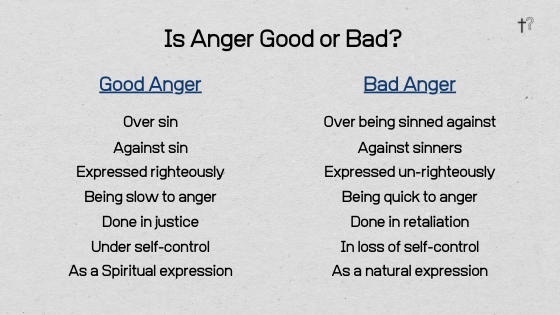
Right source: Jesus' anger rose from love for God's honour, never from wounded pride or a personal slight. The first thing to ask of our own anger is where it came from: are we provoked by sin, or simply by being crossed?

Proper focus: His anger was directed at the wrong being done — the exploiting of God's house — not at the people themselves. Ours must strike at the offence, not turn to destroy the offender.

Proper control: What He did in the temple was deliberate and measured, never a loss of temper. The test for us is simple: are we governing our anger, or is it governing us?

Proper love: His anger came mingled with grief. When Mark shows Him angry at His critics, He is grieved by the hardness of their hearts (Mark 3:5) — indignant at the sin, aching over the sinner. Anger that has stopped loving the person has lost its ultimate motive.

Proper duration: He did not let anger harden into bitterness or hoard it as a grudge. He dealt with the wrong and moved on. Ours is meant to be the same — resolved, not nursed until it sours into resentment.

Proper end: His anger served God's purpose and bowed to God's Word. So the last question is the plainest: is ours seeking justice, or seeking revenge?

good anger vs bad

James said it well:

James 1:19-20 (NKJV)

So then, my beloved brethren, let every man be swift to hear, slow to speak, slow to wrath; for the wrath of man does not produce the righteousness of God.

Our anger seldom produces righteousness because it seldom comes from a righteous place. God's anger always does, because it always flows from who He is. A God who could look upon cruelty, injustice, and the ruin of what He made and feel nothing would not be a kinder God. He would be an indifferent one. The wrath of God is the measure of how seriously He takes the things — and the people — He loves.

WE SHOULD BE ANGRY AT SIN, BUT WE SHOULD NOT SIN IN BEING ANGRY.

Who is God?

Who is God?

Last Updated

May 26, 2020

Reading Time 'Minutes'

Word Count

God Is Truth

Jeremiah 10:10 (ESV)
But the Lord is the true God; he is the living God and the everlasting King. At his wrath the earth quakes, and the nations cannot endure his indignation.

God is Light

1 John 1:5  (ESV)
This is the message we have heard from him and proclaim to you, that God is light, and in him is no darkness at all.

God is Love

1 John 4:8 (ESV)
Anyone who does not love does not know God, because God is love.

God Is Infinite

Psalm 147:5  (ESV)
Great is our Lord, and abundant in power; his understanding is beyond measure.

God is All Knowing

1 John 3:20 (ESV)
20 for whenever our heart condemns us, God is greater than our heart, and he knows everything

God is Everywhere

Psalm 139:7-12 (ESV)
7 Where shall I go from your Spirit? Or where shall I flee from your presence?
8 If I ascend to heaven, you are there! If I make my bed in Sheol, you are there!
9 If I take the wings of the morning and dwell in the uttermost parts of the sea,
10 even there your hand shall lead me, and your right hand shall hold me.
11 If I say, “Surely the darkness shall cover me, and the light about me be night,”
12 even the darkness is not dark to you; the night is bright as the day, for darkness is as light with you.

God is Unequaled

Isaiah 40:25 (ESV)
25 To whom then will you compare me, that I should be like him? says the Holy One.

God Is Perfect

1 Kings 8:27 (ESV)
“But will God indeed dwell on the earth? Behold, heaven and the highest heaven cannot contain you; how much less this house that I have built!

God Is Invisible

1 Timothy 1:17 (ESV)
17 To the King of the ages, immortal, invisible, the only God, be honor and glory forever and ever. Amen.

God Is Without Limit

Jeremiah 23:23-24 (ESV)
23 “Am I a God at hand, declares the Lord, and not a God far away? 24 Can a man hide himself in secret places so that I cannot see him? declares the Lord. Do I not fill heaven and earth? declares the Lord.

God Is Eternal

Psalm 90:2 (ESV)
2 Before the mountains were brought forth, or ever you had formed the earth and the world, from everlasting to everlasting you are God.

God Is Incomprehensible

Romans 11:33 (ESV)

Oh, the depth of the riches and wisdom and knowledge of God! How unsearchable are his judgments and how inscrutable his ways!

God Is The Almighty One

Revelation 1:8 (ESV)
“I am the Alpha and the Omega,” says the Lord God, “who is and who was and who is to come, the Almighty.”

God Is Most Wise

Jude 25 (ESV)
to the only God, our Savior, through Jesus Christ our Lord, be glory, majesty, dominion, and authority, before all time and now and forever. Amen

God Is Most Holy

Revelation 4:8 (ESV)
And the four living creatures, each of them with six wings, are full of eyes all around and within, and day and night they never cease to say, “Holy, holy, holy, is the Lord God Almighty, who was and is and is to come!”

God Is Gracious

Exodus 33:19 (ESV)
And he said, “I will make all my goodness pass before you and will proclaim before you my name ‘The Lord.’ And I will be gracious to whom I will be gracious, and will show mercy on whom I will show mercy.

God Is Merciful

Exodus 34:6 (ESV)
The Lord passed before him and proclaimed, “The Lord, the Lord, a God merciful and gracious, slow to anger, and abounding in steadfast love and faithfulness,

God Is Long-suffering

Exodus 34:6 (ESV)
The Lord passed before him and proclaimed, “The Lord, the Lord, a God merciful and gracious, slow to anger, and abounding in steadfast love and faithfulness,

God Is Forgiving

Daniel 9:9 (ESV)
To the Lord our God belong mercy and forgiveness, for we have rebelled against him

That is just a glimpse of who God is?

And This God... IS for you... IS with you... and IS in love with you.

This God... IS for you... IS with you... and IS in love with you.

SEE SIMILAR QUESTIONS

What does it mean to fear God?

The concept of the “fear of the Lord” is a key theme in the Bible. Understanding this term is crucial for a deeper comprehension of our relationship with God.

Why does God allow sin to exist?

A straightforward explanation as to why God allows sin in the world, and the overarching reason behind all His actions, is for one ultimate purpose: His glory.

What is the difference between God’s Sovereignty and God’s providence?

In Christian theology, the concepts of God’s sovereignty and providence are often discussed in tandem.

Is anger good or bad?

Does a loving God get angry? In the Bible His anger is not the opposite of His love but an expression of it. Here is what Scripture teaches about God’s wrath.

Who is God?

Here are few examples of who God is. His nature and everything about Him.

If we are to love our enemies, should not God also love Satan?

If we are to love our enemies, should not God also love satan?

Last Updated

Jul 23, 2026

Reading Time 'Minutes'

Word Count

Jesus commands His people to love their enemies: “Love your enemies, bless those who curse you, do good to those who hate you, and pray for those who spitefully use you and persecute you” (Matthew 5:44). If that is the standard God holds us to, a fair question follows. Satan is God's great enemy — so is God bound by His own command? Ought He to love the devil, and ought we?

The answer is no, and the reason is not that God falls short of His own standard. It is that the command was never about a being like Satan in the first place. To see why, we have to be clear about what God's love actually is. His love is not a blanket approval of everything that exists, a feeling that embraces good and evil alike. God's love flows in perfect harmony with His holiness and justice; He cannot look upon wickedness with favour, and to imagine Him loving evil itself would be to imagine a God at war with His own nature. Satan is not a flawed creature with some good left in him to be loved. Scripture presents him as evil without remainder — “a murderer from the beginning,” who “does not stand in the truth, because there is no truth in him,” and who “is a liar and the father of it” (John 8:44). There is nothing in him for holy love to reach.

When Jesus tells us to love our enemies, He is speaking of human enemies — the neighbour who wrongs us, the persecutor who hates us. And every human enemy, however hostile, shares one thing with us that changes everything: he is made in the image of God. That is why he can be loved and prayed for. However far he has fallen, he remains a creature God made to bear His likeness, and a creature for whom Christ's offer of mercy still stands. Our love for our enemies is really a reflection of God's own — the same patience that held back judgment while we ourselves were still His enemies.

Satan stands entirely outside that circle. He is not a fallen human but a fallen angel, and Scripture never once holds out the possibility of his redemption. His end is not restoration but judgment: “The devil, who deceived them, was cast into the lake of fire and brimstone… and they will be tormented day and night forever and ever” (Revelation 20:10). To love a being God has appointed to final destruction, with no offer of mercy extended to him, would not be Christlikeness. It would be a confusion about good and evil that Christ never asks of us.

This is why the command to love our enemies never blurs the Christian's stance toward the devil himself. We are told to love the human beings Satan uses; we are never told to love Satan. Toward him the posture is resistance, not affection — “Be sober, be vigilant; because your adversary the devil walks about like a roaring lion, seeking whom he may devour. Resist him, steadfast in the faith” (1 Peter 5:8–9). Paul draws the line in the same place: our real struggle “is not against flesh and blood, but against principalities, against powers… against spiritual hosts of wickedness in the heavenly places” (Ephesians 6:12). We fight the enemy; we love the people. Keeping those two apart is not a failure of love but the shape of it. Love reaches as far as God's mercy reaches — to every image-bearer, however hostile — and no further.

SATAN IS, IN FACT, EVERYTHING THAT GOD HATES. SATAN'S HEART IS FIXED ON HIS REBELLION AGAINST GOD, AND HIS DESTRUCTION IS INEVITABLE.