
Why is Jesus called Son of God?

Why is Jesus called 'Son of God'?

Last Updated

Jul 16, 2026

Reading Time 'Minutes'

Word Count

Jesus is called God's Son all through the New Testament. However, while reading the scriptures, you will also notice that the title ‘Son of God’ is also used in reference to human beings, to angels, to the nation of Israel and to King David. So before we can say why it matters so much that Jesus bears this title, we have to see how it is used of everyone else, and then how His sonship differs from them all.

Let’s take a look at some of the Bible's references to the ‘Sons of God’.

Human beings in general are called ‘God's children.’ God created us and sustains us and as a human father provides for his family, God also provides for us, though much more significantly.

Acts 17:28 (NKJV)

for in Him we live and move and have our being, as also some of your own poets have said, ‘For we are also His offspring.’

The angels are called Sons of God because God sustains them and for their role in carrying out His commands.

Job 1:6 (NKJV)

Now there was a day when the sons of God came to present themselves before the LORD, and Satan also came among them.

The nation of Israel is called ‘God's son’ by covenant. When God redeemed Israel out of Egypt, He claimed the nation as His own son. Israel did not come to be as other nations did. God formed it by His own hand and bound the nation to Himself by covenant.

Exodus 4:22 (NKJV)

Then you shall say to Pharaoh, ‘Thus says the LORD: “Israel is My son, My firstborn.”’

King David was called the Son of God in the sense of his office — as God’s anointed representative on the throne.

2 Samuel 7:14 (NKJV)

I will be his Father, and he shall be My son.

It is clear that the phrase the Son of God is used for a variety of purposes. However, in every one of those cases the sonship is derived. Humanity is son by creation, angels by service, Israel by covenant, David by office. Each was made a son. But Jesus was not made anything. He is the Son by nature — the eternal Son who has always been what He is, of one being with the Father (John 1:1, 18).

And it explains why His sonship was so explosive to those who first heard Him claim it. In the first century, a son took up his father’s trade; a son’s work was his father’s work. So to call God His own Father was to say He did the Father’s work — to forgive sins, to give life to the dead, to judge the world. These are not things a creature does. Yet these are exactly the works Jesus claimed as His own. His hearers understood Him perfectly:

John 5:18 (NKJV)

Therefore the Jews sought all the more to kill Him, because He not only broke the Sabbath, but also said that God was His Father, making Himself equal with God.

Notice what they heard: not a lesser title, but a claim of equality with God — and they were right to hear it that way. Jesus did not correct them. He pointed them to the very same evidence:

John 10:37-38 (NKJV)

If I do not do the works of My Father, do not believe Me; but if I do, though you do not believe Me, believe the works, that you may know and believe that the Father is in Me, and I in Him.

The works prove the sonship — not the other way round. He does what only God does because He is what only God is.

Here, then, is the difference. Humanity is God's offspring in creation. The angels are God's sons in service. Israel was God's son in covenant. David was God's son in office. But Jesus is God's Son in being. The others bear the title; He is the title. That is the difference.
Jesus is the Son of God by virtue of His position in the Trinity as the Son.

Is Jesus a created being?

Is Jesus a created being?

Last Updated

Jul 16, 2026

Reading Time 'Minutes'

Word Count

The question of whether Jesus Christ is eternal or a created being strikes at the heart of Christian theology. Understanding the nature of Jesus is not just a theological exercise but a foundational aspect of the Christian faith.

The quick answer is that Jesus is not a created being. He has eternally existed together with the Father and the Holy Spirit.

While many Christians are familiar with this answer, some groups — chiefly the Jehovah’s Witnesses — oppose it from the book of Colossians, where Paul writes:

Colossians 1:16 (NKJV)

For by Him all things were created that are in heaven and that are on earth, visible and invisible, whether thrones or dominions or principalities or powers. All things were created through Him and for Him.

At first glance this is the opposite of their claim — it says Christ created everything. However their New World Translation inserts a word the Greek does not contain, making it read “by means of him all [other] things were created.” That one bracketed word quietly turns the Creator of all things into the first of many created things. Remove it, and the verse says what the church has always confessed: all things were made by Christ and for Christ — which means He cannot be among the created.

Additionally, Colossians 1:15 is also incorrectly used to justify the argument that Jesus was created by highlighting the word “firstborn”:

Colossians 1:15 (NKJV)

He (Jesus) is the image of the invisible God, the firstborn over all creation.

However, to better understand how the word ‘firstborn’ is used, let's look at another verse:

Psalm 89:27 (NKJV)

Also I will make him My firstborn, The highest of the kings of the earth.

The above Psalm addresses King David as the firstborn son of Jesse — but was David actually Jesse's firstborn son? No, he was the youngest of Jesse’s sons (1 Samuel 16:11).

So why does the verse refer to him as the firstborn? Because “firstborn” was never only about birth order. In the ancient world the firstborn son held a place of rank — the chief heir, first in honour and inheritance. To call David God’s “firstborn… the highest of the kings of the earth” is to name his supremacy among kings, not the order of his birth. And that is exactly how the title works for Christ. He is the firstborn over all creation not because He was the first one made, but because He holds the highest place over all of it — the pre-eminent and rightful heir of everything that exists.

Paul does not leave the point to a single word. Read on, and he closes every door to the idea that Christ is a creature.

Colossians 1:17 (NKJV)

And He is before all things, and in Him all things consist.

“He is before all things” — before all things, which can only mean before creation itself, since there was nothing else to precede. The One who exists before everything, and holds everything together, is plainly not part of the everything He made.

Jesus said the same of Himself, again and again. He spoke of the glory He shared with the Father “before the world was” (John 17:5), of having “come down from heaven” (John 6:62), of belonging to a realm above this one: “You are from beneath; I am from above” (John 8:23). John gathers it into one verdict: “All things were made through Him, and without Him nothing was made that was made” (John 1:3). That statement is without exception — nothing was made without Him.

So the answer stands. Jesus is not a created being. He is the eternal Son, the Maker of all things and the heir of all things, who in the fullness of time entered the world He had made, to redeem a people for Himself.

THROUGH HIM ALL THINGS WERE MADE; WITHOUT HIM NOTHING WAS MADE...

JOHN 1:3

What does it mean that Jesus is the passover lamb?

What does it mean that Jesus is the passover lamb?

Last Updated

Jul 16, 2026

Reading Time 'Minutes'

Word Count

No event in the Old Testament foreshadows the cross more clearly than the Passover.

The Passover begins in Egypt, where God's people had lived under brutal slavery for generations, forced into hard labour under Pharaoh. Through the prophet Moses, God confronted Pharaoh again and again, sending plague after plague — each a direct blow against the false gods of Egypt (Exodus 12:12) — and demanding that His people be released. Pharaoh refused every time. And so, as His final act of judgement, God declared that at midnight every firstborn son in the land of Egypt would die.

But for the Israelite families living in that same land, God provided a way of escape. Each household was to take a spotless lamb, kill it, and mark the doorframe of their home with its blood. That night the LORD passed through the land; the destroyer struck every house without the mark and passed over every house that carried the blood (Exodus 12:23). By morning, while Egypt mourned, the people of Israel walked out free.

The meaning was unmistakable. A lamb died so that people could live. The judgement did not skip the house — it fell on the lamb instead. A substitute had absorbed what would otherwise have fallen on them.

God commanded His people to remember this event on an annual basis through the Passover feast — a meal where every generation shared the same bread, retold the same story, and passed on the same memory to their children: we were slaves, God provided a lamb, and the blood on the door kept death away. It was never merely a history lesson. Year after year, Israel was reminded that their freedom had been bought through the blood of a substitute.

Centuries later, it was no accident that Jesus was crucified at the time of Passover. God had ordered every detail of redemptive history so that the true Lamb would die at the very festival that had been pointing to Him all along.

Before Jesus' public ministry had even begun, John the Baptist saw Him approaching and cried out, “Behold! The Lamb of God who takes away the sin of the world!” (John 1:29). It was a startling thing to say. To call a man “the Lamb of God” was to gather up the entire sacrificial system — every lamb Israel had ever offered — and lay it on one person. John was claiming that this was the One those centuries of sacrifices had been pointing to all along.

The Apostle Paul made the connection explicit: “Christ, our Passover, was sacrificed for us” (1 Corinthians 5:7). Once you see Jesus as the Passover Lamb, two things become staggering at once — how far He surpasses the original, and how precisely He fulfils it.

Consider first how He surpasses it. The Passover lamb spared a household for a single night; the blood of Jesus saves people from every tribe and nation for eternity. The lamb's blood protected Israel from one act of judgement; Christ's blood delivers us from eternal judgement. The lamb freed Israel from Pharaoh's grip; Christ frees us from the slavery of sin and death itself.

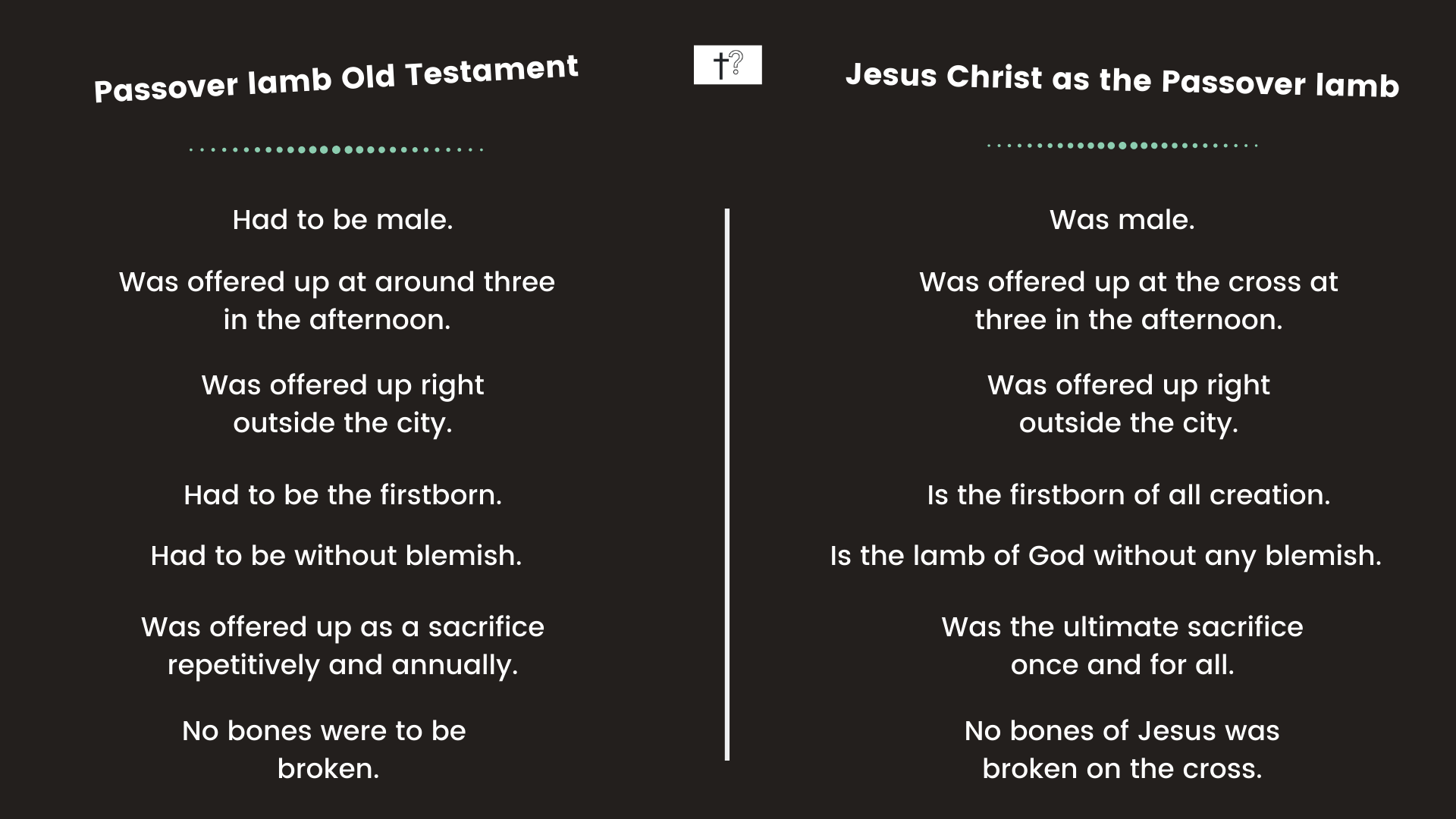
Now consider how precisely He fulfils it. The lamb had to be male — Jesus was male. It had to be without blemish — Jesus was the sinless Lamb of God (Exodus 12:5). Not one of its bones was to be broken — and when Jesus died, the soldiers found Him already dead and broke none of His bones, exactly as Scripture had said (Exodus 12:46; John 19:36). And by Jesus' day the lambs were slain in the mid-afternoon, around three o'clock — the very hour at which Jesus gave up His spirit (Mark 15:34–37). Year after year, lamb after lamb, Israel had been rehearsing the details of a sacrifice whose true fulfilment lay centuries ahead.

There is one last thing the Passover teaches, and it is personal. In Egypt it was not enough that the lamb was killed; the blood had to be applied — brushed onto the doorframe of each home. A lamb slain in the yard saved no one. Only the blood on the door turned death away (Exodus 12:13). So it is with Christ. That He died as the true Passover Lamb is the heart of the gospel — but the question it presses on every reader is whether His blood marks your door. The Lamb has been slain; what remains is to take shelter under the blood.

Jesus is the lamb that was offered up for our sins once and for all.

Why Was Jesus Baptized?

Why did Jesus take Baptism?

Last Updated

Jul 16, 2026

Reading Time 'Minutes'

Word Count

As John the Baptist baptized people, he proclaimed that the baptism of the coming Messiah would be far greater than his own.

Matthew 3:11 (NKJV)

I indeed baptize you with water unto repentance, but He who is coming after me is mightier than I, whose sandals I am not worthy to carry. He will baptize you with the Holy Spirit and fire.

So when Jesus came to him asking to be baptized, John was troubled. He felt unqualified, and wanted Jesus to baptize him instead.

Matthew 3:13-15 (NKJV)

Then Jesus came from Galilee to John at the Jordan to be baptized by him. And John tried to prevent Him, saying, “I need to be baptized by You, and are You coming to me?” But Jesus answered and said to him, “Permit it to be so now, for thus it is fitting for us to fulfill all righteousness.” Then he allowed Him.

John's instinct was sound: his was a baptism of repentance, a washing for sinners who turned from their sin. Jesus had no sin to repent of. So why would the sinless Son of God step into a river meant for the guilty? Scripture points to several reasons.

  • Identification with sinners: In being baptized, Jesus took His place among the contrite people of God who came to John in repentance — and not among the watching Pharisees who stood apart in self-righteous judgment. From the start, He stood where sinners stand.
  • Intercessory identification: Like the Old Testament intercessors who stood before God on behalf of a guilty people — Moses, Daniel, and others — Jesus stepped into the sinner's place. He did so not to confess any sin of His own, for He had none, but to identify with those whose sin He had come to bear.
  • Affirmation of His messiahship: At the Jordan the Father testified audibly from heaven and the Spirit descended, publicly confirming Jesus as the beloved Son and the promised Messiah.
  • The beginning of His public ministry: The baptism marked the opening of His public work, from which He would carry the message of salvation to all.
  • Endorsement of John's ministry: By submitting to John's baptism, Jesus affirmed John's God-given mission and the call to repentance at its heart.
  • An example of obedience: In willingly submitting to baptism, Jesus set a pattern for His followers, showing baptism to be an act of obedience to God.

Jesus gives the answer Himself: His baptism was “to fulfill all righteousness” (Matthew 3:15). He was not confessing sin, for He had none. He was doing the whole will of God on our behalf, taking His place among the very people He had come to save.

This is the crucial difference between confession and identification. The repentant who came to John confessed sins that were truly their own. Jesus identified with a guilty people — not because He shared their guilt, but because He had come to bear it. The Jordan pointed forward to the cross, where that identification would be carried to its end.

2 Corinthians 5:21 (NKJV)

For He made Him who knew no sin to be sin for us, that we might become the righteousness of God in Him.

Jesus, the perfect man, did not need baptism for the repentance of sin. Still, He accepted the act of baptism in obedience and as an example for us to follow.

JESUS WILL BAPTIZE YOU WITH THE HOLY SPIRIT AND FIRE.

What does it mean that Jesus grew in wisdom?

What does it mean that Jesus grew in wisdom?

Last Updated

Jul 16, 2026

Reading Time 'Minutes'

Word Count

Luke tells us twice that Jesus grew. As a child, He “grew and became strong in spirit, filled with wisdom, and the grace of God was upon Him” (Luke 2:40). And again, a few verses later, He “increased in wisdom and stature, and in favor with God and men” (Luke 2:52).

These passages raise a profound question: if Jesus is God, how can He grow in wisdom? Is not omniscience, the state of being all-knowing, an inherent characteristic of God? So how can the One who knows everything increase in anything?

Here is the heart of the answer. Jesus is one person in two natures — fully God and fully man. As God, the Son knows all things and does not change. As man, He had a real human mind that began as an infant's and grew, as every human mind grows. Both are true of the same person, because that person is both God and man. So when Luke writes that Jesus “increased in wisdom,” he is telling us the truth about the Son of God — according to His humanity. The eternal Son did not grow wiser in His deity. He grew in wisdom in the human nature He had taken to Himself.

There is no contradiction here, because the two natures were not in competition. Even as His human mind was learning its first words, the same Son, as God, was upholding the universe and knowing all things (Colossians 1:17). The infinite was not shrunk to fit the manger. The eternal Son took up a true human life and lived it from the inside — while never, for a moment, ceasing to be all that God is.

Also unlike Adam, who was created as a grown man, Jesus was conceived and born and grew like any other child — yet without sin, and without the inherited guilt of Adam (Luke 1:35; Westminster Confession 8.2). He learned to speak, to read the Scriptures, to reason. By the age of twelve His understanding already astonished the teachers in the temple:

Luke 2:47 (NKJV)

And all who heard Him were astonished at His understanding and answers.

Scripture also shows us how His human life was sustained — by the Holy Spirit. The child who grew in wisdom did so as the Spirit rested upon Him, exactly as Isaiah had foretold:

Isaiah 11:2 (NKJV)

The Spirit of the LORD shall rest upon Him, the Spirit of wisdom and understanding, the Spirit of counsel and might, the Spirit of knowledge and of the fear of the LORD.

The Son of God, living a genuinely human life, drew His human wisdom and strength from the Spirit — as we are meant to.

This is also what Paul means by the famous “emptying.” Writing of Christ's humility, he says the Son “made Himself of no reputation” — in Greek, ekénōsen, “He emptied Himself,” from which we get the word kenosis:

Philippians 2:5–8 (NKJV)

Let this mind be in you which was also in Christ Jesus, who, being in the form of God, did not consider it robbery to be equal with God, but made Himself of no reputation, taking the form of a bondservant, and coming in the likeness of men. And being found in appearance as a man, He humbled Himself and became obedient to the point of death, even the death of the cross.

The emptying is the taking. Christ emptied Himself not by subtraction — pouring out His deity or laying down His divine attributes — but by addition: “taking the form of a bondservant.” He veiled His glory beneath a real human life and submitted Himself to the Father's will; He did not vacate His divinity to do it.

This is why the Reformed tradition has always rejected the kenotic theology of certain writers, who read Philippians 2 to mean that Christ surrendered some of His divine attributes and became, for a time, less than God. If that were true, He would not have been God on earth — and the Saviour we needed must be fully God, or His death could not save.

The gospels record moments when His divine knowledge broke plainly through the veil: He knew men's thoughts (Matthew 9:4), needed no one to tell Him what was in a person (John 2:24–25), knew a stranger's whole history and a friend's death from far away (John 4:17–18; 11:11–14). And there were things He asked about, and learned, and grew into, as a man.

This even answers the verse where Jesus says no one knows the hour of the end times — not even the Son, but only the Father (Mark 13:32). How can the omniscient Son not know? In the very same way He could grow in wisdom at all: according to His human nature. As God, He knew the day. As man — in the knowledge He lived by, day to day, in submission to the Father — it had not been given Him.

The Son of God did not merely appear to be human. He took a true human nature and grew up inside it — learning to speak, to reason, to obey — so that there is no part of our weakness He has not passed through Himself. That is why He is the High Priest we needed: not one who watches our frailty from a distance, but one who “can sympathize with our weaknesses,” having been “in all points tempted as we are, yet without sin” (Hebrews 4:15). The God who knows all things learned, as a child, what it is to be us.

In conclusion, Jesus' growth in wisdom as described in Luke is a profound illustration of His complete humanity. While He never ceased to be fully divine, He embraced the human experience, including learning and growing in wisdom. This aspect of Jesus' life demonstrates His humility and identification with humanity, but also establishes Him as a Great High Priest, uniquely able to sympathize with our weaknesses (Hebrews 4:14-16).

Christ was therefore subject to the normal process of human growth—intellectually, physically, spiritually, and socially.

How can Jesus be both God and Man?

How can Jesus be both God and man?

Last Updated

Jul 16, 2026

Reading Time 'Minutes'

Word Count

The statement that “Jesus was 100% God and 100% man” or “truly God and truly man” is something you may have heard in Church. But what does this profound statement really mean?

To put it simply, Jesus existed as God before He existed as a human being.

Many have wrongly understood the nature of Christ by believing that He was created first as a man and then attained divinity. The early church gave this error a name: adoptionism — the idea that God ‘adopted’ the man Jesus as His Son at some point in His life. The Church rejected it in the second century, on the testimony of the New Testament that Jesus already existed as God before He was conceived in Mary’s womb (John 1:1; Philippians 2:6; Colossians 1:15–17).

The Son has always existed as the second person of the Trinity. In the fullness of time He entered our world, taking on flesh so that He might offer Himself as a sacrifice for our sins.

This belief in Jesus' dual nature was solidified in early Christian theology and articulated in the Council of Nicaea (AD 325) and the Chalcedonian Creed (AD 451). These crucial gatherings of Christian leaders established that Jesus is both fully divine and fully human, two natures coexisting in one person without confusion, change, division, or separation.

Scripturally, this concept is supported by passages like John 1:1,14, which states that “the Word was God” and “the Word became flesh.” Additionally, Philippians 2:6-8 speaks of Jesus, who, being in the form of God, took on the nature of a servant, being made in human likeness. Colossians 2:9 further affirms this, “For in Him dwells all the fullness of the Godhead bodily.”

It is also important to note that Jesus did not cease to be God in the incarnation; rather, He added the nature of humanity to His divinity.

In becoming man, Jesus did not become another ‘person’, but instead took on / added to Himself the human nature, which is how Jesus could be truly God and truly man.

This union of divine and human nature in Jesus is crucial for understanding His unique role in salvation history. His divine nature ensures the effectiveness of His sacrificial death, while His human nature enables Him to empathize with our weaknesses and represent us before God (Hebrews 4:15-16).

Jesus is fully God and fully man — one person, two natures, held together without compromise on either side. He alone could bear both the weight of our sin and the wrath that sin had earned.

Jesus took on this role not for a mere display of His divinity but rather in Humility displayed for us all the love of God on the Cross.