
Justification, Sanctification and Glorification?
One salvation, three phases — past, present and future. Justification is a finished verdict that settles your standing before God. Sanctification is a lifelong work that changes what you are actually like. Glorification is the day God finishes the job. Nobody who receives the first fails to receive the third.
Salvation is one work of God, and Scripture describes it in three tenses. You have been saved from the penalty of sin. You are being saved from the power of sin. You will be saved from the presence of sin. Theologians call these three things justification, sanctification and glorification.
They are not three separate salvations but one salvation in three phases — past, present and future. Justification is a finished verdict that settles your standing before God. Sanctification is a lifelong work that changes what you are actually like. Glorification is the day God finishes the job. All three are God's doing, and nobody who receives the first will fail to receive the third.
There are two different questions here. The first is where do I stand with God? The second is what am I actually like? God answers the first once, at the beginning, and the answer never changes. He answers the second slowly, over the whole of your life.
Confuse them and you go wrong in one of two ways. Some Christians take the second question as the answer to the first, so a bad week means they are not really saved and a good week means they are. Their standing rises and falls with their behaviour, and they spend their lives trying to earn a place that was given to them. Others drop the second question altogether: they are forgiven, so how they live is not the point. They end up with a God who pardons men and never changes them.
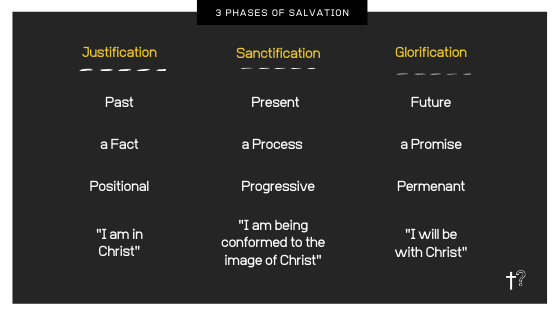
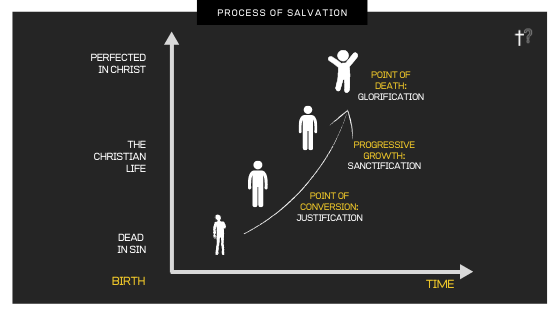
Justification: God declares you righteous
Picture a courtroom. A man stands in the dock, the evidence has been heard, and the judge delivers his verdict: guilty, or not guilty. Nothing about the man himself changes in that moment. He walks out the same person he walked in as. What has changed is his position before the law — whether he is condemned or clear.
That is what the word justify means in the Bible. It is a courtroom word. To justify a man is not to make him better; it is to declare him righteous, and its opposite is not to make him worse but to condemn him. Both are rulings from the bench. One sends him down. The other lets him walk free.
So when God justifies you, He is not making you good. He is declaring where you stand with Him. Nothing about your character has been repaired yet — that work comes next, and it takes a lifetime. What has changed is your standing, and it changed from outside you. The Judge handed it down. You did not produce it.
But that raises a fair question. If the man in the dock is guilty, and the judge calls him righteous, the judge has said something untrue. And a judge who clears a guilty man is not being kind. He is failing at the one thing a judge exists to do. So how can God say it and it be true?
Because you are not standing in the dock alone.
When you trusted Christ, God joined you to Him. Not near Him — in Him. Everything that belongs to Jesus now belongs to you.
So think about whose life is being read out over you. Jesus lived a real human life. He got tired. He went hungry. He was tempted, lied about, misunderstood by His own family and abandoned by His friends — and He obeyed His Father through every hour of it, and never sinned once. That obedience is not a story invented to cover your failures. It happened.
That is the righteousness the Judge is naming when He names you righteous. He is not looking away from your record and being kind about it. He is looking at you in Christ, and telling the truth about what He sees.
Romans 5:1 (NKJV)
Therefore, having been justified by faith, we have peace with God through our Lord Jesus Christ,
Look at the tense. Having been justified — it is behind you. Finished. And what comes out of it is peace: not a good mood that rises and falls with your week, but a settled state between you and God.
Romans 8:1 (NKJV)
There is therefore now no condemnation to those who are in Christ Jesus, who do not walk according to the flesh, but according to the Spirit.
Now. Not one day. Not once your life improves. The verdict has already been handed down, and it will not be reopened on your worst day.
Because it is a verdict, it is all or nothing. You cannot be thirty per cent justified, any more than a court can find a man mostly innocent. It happens in a moment, when you hear the gospel and believe, and it never needs doing again. A man is justified by faith apart from the deeds of the law (Romans 3:28), and by the works of the law no flesh shall be justified (Galatians 2:16).
Which leaves one question. If God does all of it, what is faith doing? Faith is not your share of the work — the part you bring while God brings the rest. A dead man does not decide to start breathing. Faith is the first thing the new life does, which is why the Bible calls it a gift rather than an achievement. You are not justified because you believed, as though believing were the last small thing God still needed from you. You are justified through believing, and the believing itself was given to you. God does not start your salvation and then step back to see whether you will finish it.
Click to view Bible verses on Justification
Romans 3:28 (ESV) For we hold that one is justified by faith apart from works of the law.
Romans 5:1 (ESV)Therefore, since we have been justified by faith, we have peace with God through our Lord Jesus Christ.
Romans 8:1 (ESV) There is therefore now no condemnation for those who are in Christ Jesus.
Galatians 2:16 (ESV) yet we know that a person is not justified by works of the law but through faith in Jesus Christ, so we also have believed in Christ Jesus, in order to be justified by faith in Christ and not by works of the law, because by works of the law no one will be justified.
Sanctification: God makes you like Christ
There are two halves to this. The first has already happened to you.
To sanctify something means to set it apart — to take it out of ordinary use and mark it as belonging to God. That is what happened to you. Scripture never speaks of believers as people working towards being set apart. It speaks of it as something already done to them.
1 Corinthians 6:11 (NKJV)
And such were some of you. But you were washed, but you were sanctified, but you were justified in the name of the Lord Jesus and by the Spirit of our God.
Every verb there is in the past tense. And look at who Paul is writing to. The church at Corinth had split into factions, its members were taking each other to court, and it was tolerating a sexual scandal in its own congregation. They do not sound like people set apart for God. Paul calls them sanctified anyway — because he is not describing how they are doing. He is describing what God has done to them.
That is why the New Testament calls ordinary, struggling Christians saints. The word has never meant someone who has arrived. It means someone God has claimed. You are His already: on the days it shows, and on the days it does not.
Being claimed is not the end of it. God does not take a man as His own and leave him as he was. He begins to change him — slowly, across a lifetime — until he looks like Jesus. Sin is put to death a little at a time, and obedience grows up in its place. It is not tidy. There are weeks you gain ground and weeks you lose it, and over years, by God's grace, you are not the man you were. You will not be perfect in this life. Anyone who tells you otherwise is setting you up to despair.
Philippians 2:12–13 (NKJV)
Therefore, my beloved, as you have always obeyed, not as in my presence only, but now much more in my absence, work out your own salvation with fear and trembling; for it is God who works in you both to will and to do for His good pleasure.
Those two verses belong together, and taking one without the other produces two different mistakes. Verse 12 on its own gives you a Christian trying to earn what he already has. Verse 13 on its own gives you a Christian who does nothing and calls it grace. Together they say this: God works in, and you work out. You are not working for a salvation you do not have. You are working out the one He has already put in you.
So the effort is real, and it matters. A Christian who neglects his Bible, his prayers and the company of God's people will find himself stuck, and he should not be surprised when he does. But even the effort is not finally yours. God is the one who produces both the wanting and the doing. And notice how He does it. Paul says that we all, with unveiled face, beholding as in a mirror the glory of the Lord, are being transformed into the same image from glory to glory (2 Corinthians 3:18). Not straining until you change. Looking at Christ, until you have.
Change is also evidence that the verdict was passed, and it is one of the ordinary ways God gives His people confidence. Where there is no change at all across years, that is a reason to ask whether the verdict was ever passed. Because God does not declare a man righteous and then leave him exactly as He found him. If anyone is in Christ, he is a new creation (2 Corinthians 5:17). But be clear what the evidence is for. It shows you the verdict is yours. It did nothing to bring it about.
Click to view Bible verses on Sanctification
Romans 6:19 (ESV) I am speaking in human terms, because of your natural limitations. For just as you once presented your members as slaves to impurity and to lawlessness leading to more lawlessness, so now present your members as slaves to righteousness leading to sanctification.
Philippians 2:12-13 (NIV) 12 Therefore, my dear friends, as you have always obeyed—not only in my presence, but now much more in my absence—continue to work out your salvation with fear and trembling, 13 for it is God who works in you to will and to act in order to fulfill his good purpose.
1 Thessalonians 4:3 (NIV) It is God's will that you should be sanctified: that you should avoid sexual immorality;
Glorification: God finishes the work
Glorification is the day God finishes what He started. When Christ returns, the dead in Christ are raised, and every believer is given a new body — one that cannot decay, cannot fail and cannot die. What you are on that day is what you will be for ever.
1 John 3:2 (NKJV)
Beloved, now we are children of God; and it has not yet been revealed what we shall be, but we know that when He is revealed, we shall be like Him, for we shall see Him as He is.
It is not only your body that is put right. Paul speaks of the redemption of the body, but God is not repairing a house and leaving the man inside it as he was. Think about what sin has done to your mind: the thoughts you would be ashamed to say out loud, the envy that arrives before you can stop it, the pride you keep finding underneath your best moments. Think about what it has done to what you love — how easily your heart wants the wrong thing, and how slowly it wants God. All of that goes. You will not sin again. And more than that: you will not want to.
That does not make you God. We shall be like Him — like, not equal. You will still be a human being on that day, and still a creature with limits, standing before a God who has none. You are not absorbed into Him. You are not made divine. You are made everything a human being was meant to be, which you have never yet seen in yourself or in anyone else.
And the long list of things you have carried since the day you were born comes to an end. Illness. Decay. Pain. Grief. Death. God will wipe away every tear from their eyes (Revelation 21:4).
Click to view Bible verses on Glorification
Romans 8:16-17 (ESV) The Spirit himself bears witness with our spirit that we are children of God, 17 and if children, then heirs-- heirs of God and fellow heirs with Christ, provided we suffer with him in order that we may also be glorified with him.
2 Corinthians 4:17 (ESV) For our momentary light affliction is producing for us an absolutely incomparable eternal weight of glory.
Philippians 3:21 (NIV) who, by the power that enables him to bring everything under his control, will transform our lowly bodies so that they will be like his glorious body.
Revelation 21:4 (NIV) 'He will wipe every tear from their eyes. There will be no more death' or mourning or crying or pain, for the old order of things has passed away."
Philippians 1:6 (NIV) being confident of this, that he who began a good work in you will carry it on to completion until the day of Christ Jesus.
The chain that holds all three together
One passage puts the whole sequence in a single sentence, and it is the reason a Christian can read all of this without anxiety.
Romans 8:29–30 (NKJV)
For whom He foreknew, He also predestined to be conformed to the image of His Son, that He might be the firstborn among many brethren. Moreover whom He predestined, these He also called; whom He called, these He also justified; and whom He justified, these He also glorified.
Every link is fastened to the one before it by the same two words — He also — and God is the subject of every verb in the chain. Nobody is called who was not predestined. Nobody is justified who was not called. And nobody who is justified fails to be glorified. The older commentators called this a golden chain, because you cannot remove a link without destroying the whole thing, and no link anywhere along it is held in place by you.
Philippians 1:6 (NKJV)
being confident of this very thing, that He who has begun a good work in you will complete it until the day of Jesus Christ;
The good work in you is not yours to complete. It was not yours to begin.
Other related articles:
being confident of this, that he who began a good work in you will carry it on to completion until the day of Christ Jesus.
Phillipians 1:6