What about the missing Bible verses?

What about the missing bible verses?

Last Updated

Jan 22, 2025

Reading Time 'Minutes'

Word Count

When you compare some of the modern Bible translations (for example, NIV, ESV, HSSB) with that of the King James Version (KJV), it would seem as though there are some "missing verses."

One of the famous verses, is 1 John 5:7–8, where it says in the KJV, “For there are three that bear record in heaven, the Father, the Word, and the holy Ghost, and these three are one. And there are three that bear witness in earth.” However, this verse is missing in the most recent translations.

But didn’t Jesus promise that not a single word would be lost (Matthew 5:18)? How is it possible for there to be missing verses then? How then can we trust the Bible? Answering this question isn't as complicated as it seems.

To begin with, the KJV Bible, written in 1611 AD, utilized the best resources that were available at the time to ensure an accurate translation from the original language into the common language (English).

In the years since 1611, many older manuscripts have been discovered that were carefully evaluated by scholars. Scholars generally consider older manuscripts to be more reliable (since they are closer to the original documents). Therefore, most modern Bible translations exclude/omit verses that appear in the KJV but not in older manuscripts.

Most modern translations will still include a footnote referencing the missing verses.

It is also pertinent to note that the original Bible manuscripts were not divided into chapters and verses as we have today. These were later inventions to facilitate Bible teaching, preaching, writing, and speaking around the globe.

Following the Geneva Bible translation in 1560, the King James Bible was the first major Bible translation, which slightly altered chapter and verse divisions. This structure is now common to all modern English translations.

The tricky part for scholars is deciding what to do when the verse assigned a number in the 1500s does not appear in the original manuscript/text. Since all subsequent verses cannot be simply altered, translators will leave the verse blank and keep the original numbering. In this way, consistency is maintained; for example, if we moved John 3:16 up a verse, then everyone who quotes John 3:16 would not have the same verse.

Finally, it is important to keep in mind that no missing verse disrupts the essential Christian teachings. The key message of Jesus as the divine Son of God, the Triune Godhead, the virgin birth of Jesus, His death, burial, resurrection, ascension, and second coming all remain undeterred.

Whether you prefer the ESV, NIV, NASB, or any other modern translation, you can be confident that it is a trustworthy one. That it is "living and active" (Hebrews 4:12), "inspired by God and profitable for teaching, for reproof, for correction, for training in righteousness; so that the man of God may be adequate, equipped for every good work" (2 Timothy 3:16-17).

As important as anything else, the Bible you hold contains God's plan for salvation for us.

FOR TRULY I TELL YOU, UNTIL HEAVEN AND EARTH DISAPPEAR, NOT THE SMALLEST LETTER, NOT THE LEAST STROKE OF A PEN, WILL BY ANY MEANS DISAPPEAR FROM THE LAW UNTIL EVERYTHING IS ACCOMPLISHEd.

Mathew 5:18

Is Jesus a created being?

Is Jesus a created being?

Last Updated

Jan 8, 2025

Reading Time 'Minutes'

Word Count

Is Jesus eternal or was He created by God?

The question of whether Jesus Christ is eternal or a created being strikes at the heart of Christian theology. Understanding the nature of Jesus is not just a theological exercise but a foundational aspect of the Christian faith.

The quick answer is that Jesus is not a created being, but He existed since eternity past together with God the Father and God the Holy Spirit.

While many Christians may be familiar with this answer, it's worthwhile to note that some (mainly the Jehovah's Witnesses) oppose it.

The following verse is incorrectly used to support the claim that Jesus was created:

Colossians 1:15 (NKJV)

He (Jesus) is the image of the invisible God, the firstborn over all creation.

However, this interpretation misunderstands the biblical use of "firstborn". In order to better understand how the word 'firstborn' is used, let's look at another verse:

Psalm 89:27 (NKJV)

Also I will make him My firstborn, The highest of the kings of the earth.

This verse addresses King David as the firstborn son of Jesse, but was David actually Jesse's firstborn son?  No, he was the last-born son.

So why does the verse refer to him as the firstborn? For the same reason, it relates to Jesus as the firstborn Son of God – it refers to Him as the pre-eminent or distinguished Son.

Likewise, the verse in Colossians uses the same Greek word, 'Prototokos,' which means pre-eminent/distinguished, which, when used in context, literally means 'First in rank.' While writing Colossians, if Paul wanted to call Jesus a 'created being,' he would have used another Greek word, "Protoktistos," which can be translated as 'founded' or 'first created.'

Additionally, if we continue reading the following verses in Colossians, Paul declares 'Jesus was before all things’ meaning before creation itself:

Colossians 1:17 (NKJV)

And He is before all things, and in Him all things consist.

Even Jesus often spoke of His unique origin of having pre-existed in heaven before coming into the world (John 8:23, John 6:62, John 16:28, John 17:5, John 1:3).

Thus, we can see that Jesus is not a created being. He existed from eternity, and at the appointed time came to earth to redeem mankind.

THROUGH HIM ALL THINGS WERE MADE; WITHOUT HIM NOTHING WAS MADE...

JOHN 1:3

What does it mean that Jesus is the passover lamb?

What does it mean that Jesus is the passover lamb?

Last Updated

Jan 9, 2025

Reading Time 'Minutes'

Word Count

In the Old Testament, the Israelites (while still under Egyptian bondage) were instructed to sacrifice a lamb and apply its blood to their doorposts (to protect their firstborn from the Angel of Death) - Exodus 12.

The Passover lamb in Exodus was a critical symbol of salvation and protection for the Israelites in Egypt and it became such a memorable event in the community that they celebrated it annually as a festival called the Passover.

In the New Testament, Jesus is referred to as the Passover lamb, but what is the significance of this?

John 1:29 (NKJV)

The next day John saw Jesus coming toward him, and said, “Behold! The Lamb of God who takes away the sin of the world!

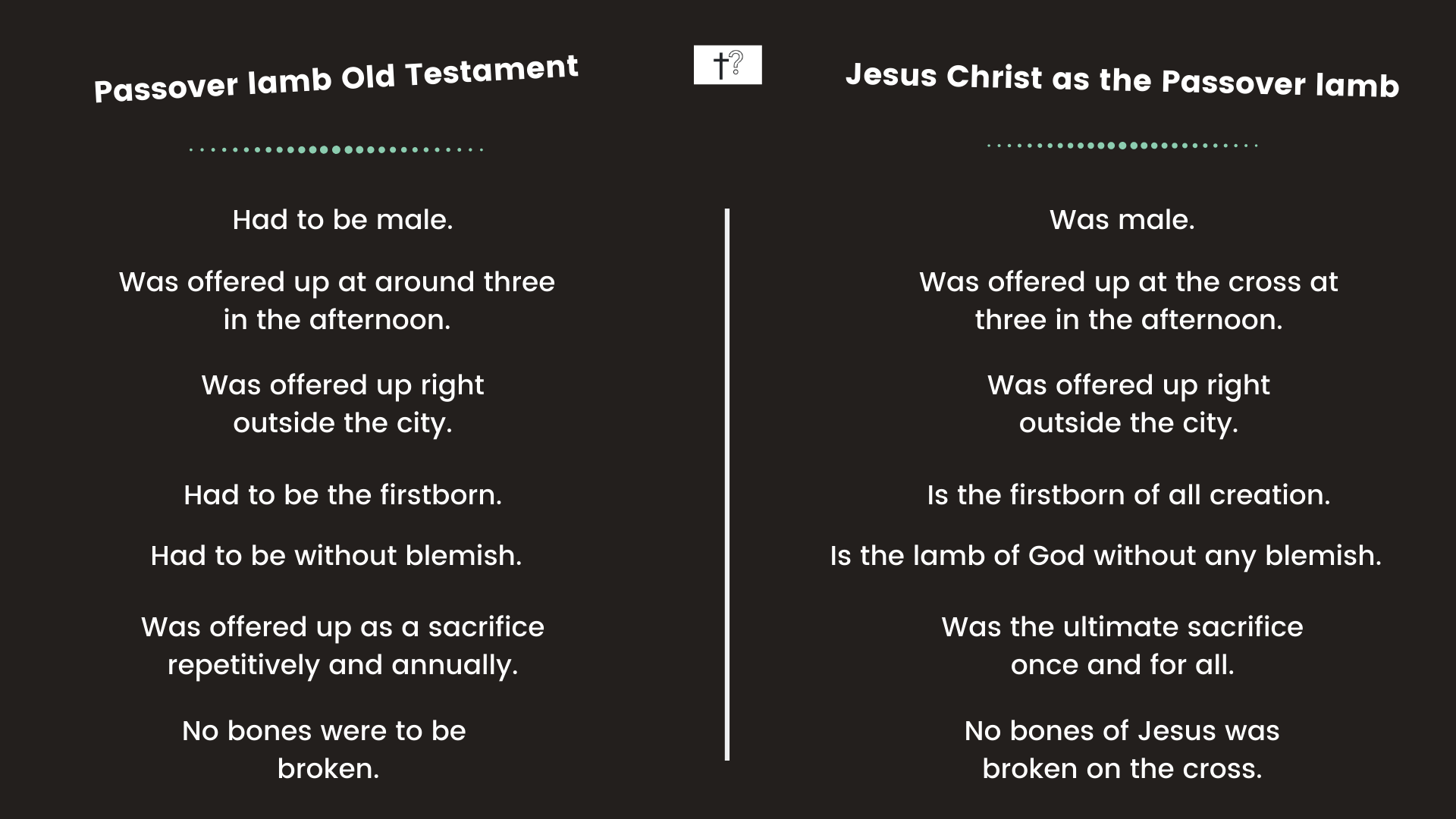
In order to better understand its relevance, let's compare Jesus to the Passover lamb of the Old Testament:

John’s the Baptist calling Christ as the Lamb of God signified the beginning of a new covenant. While the Passover lamb brought temporary atonement, Jesus, as the Lamb of God, offers permanent atonement for sin, establishing a new relationship between God and humanity based on grace and mercy.

Unlike the yearly sacrifice of a lamb, Jesus' crucifixion was a singular, all-encompassing sacrifice. His death and the shedding of His blood serve as the means of redemption for humanity, mirroring the protective symbolism of the Passover festival.

Jesus, as the Passover lamb, represents the fulfillment of ancient prophecy and is foundational to the Christian faith. His sacrifice marks a pivotal moment in history, transforming the meaning of Passover from a Jewish tradition into a profound symbolism of redemption and salvation.

For Christians today, understanding Jesus as the Passover lamb deepens the appreciation of His sacrificial death and its significance. It emphasizes the continuity between the Old and New Testaments and highlights the transformative power of Jesus' atonement in the life of believers.

Jesus is the lamb that was offered up for our sins once and for all.

Why did Jesus take Baptism?

Why did Jesus take Baptism?

Last Updated

Jan 9, 2025

Reading Time 'Minutes'

Word Count

As John the Baptist baptized people, he proclaimed that the baptism of the coming Messiah would be even more significant.

Matthew 3:11 (NKJV)

I indeed baptize you with water unto repentance, but He who is coming after me is mightier than I, whose sandals I am not worthy to carry. He will baptize you with the Holy Spirit and fire.

However, when Jesus came to him and asked to be baptized, John felt unqualified and instead wanted Jesus to baptize him.

Matthew 3:13-15 (NKJV)

Then Jesus came from Galilee to John at the Jordan  to be baptized by him.  And John tried to prevent Him, saying, “I need to be baptized by You, and are You coming to me?” But Jesus answered and said to him, “Permit it to be so now, for thus it is fitting for us to fulfill all righteousness.” Then he allowed Him.

So why did Jesus end up taking baptism?

Firstly, John’s baptism was a call to repentance for all people; however, Jesus did not perform this act for the repentance of sins because He never sinned.

Rather, through His baptism, Christ identified with us sinners as He would ultimately bear our sins, and His perfect righteousness would be imputed to us.

2 Corinthians 5:21 (NKJV)

For He made Him who knew no sin to be sin for us, that we might become the righteousness of God in Him.

Jesus was baptized for the following reasons:

    • Symbol of death & resurrection: Jesus’ baptism foreshadowed His death and resurrection, representing the new life believers should have in Him.
    • Public Identification & humility: This act marked Jesus’ first public association with those whose sins He would eventually take upon Himself, demonstrating His role as the Savior.
    • Affirmation of His Messiahship: The baptism served as a public declaration of Jesus as the Messiah, confirmed by God the Father’s testimony from heaven.
    • Commencement of Public Ministry: It marked the beginning of His public ministry, where He would bring the message of salvation to all.
    • Intercessory Role: In a manner akin to Old Testament figures like Nehemiah, Ezra, Moses, and Daniel, Jesus’ baptism symbolized a confession of sins on behalf of the nations, highlighting His role as an intercessor;
    • Support for John’s Ministry: Through His baptism, Jesus endorsed John’s ministry, validating the importance of baptism and repentance.
    • Solidarity with the repentant: Jesus in getting baptized was was identifying with the contrite / repentant people of God who came to John for baptism and repentance and not with the critical Pharisees who were only watching.
    • As an Example: Jesus’ baptism serves as an example for Christians to follow, emphasizing the importance of baptism as an act of obedience to God.

Jesus, the perfect man, did not need baptism for the repentance of sin. Still, He accepted the act of baptism in obedience and an example for us to follow.

JESUS WILL BAPTIZE YOU WITH THE HOLY SPIRIT AND FIRE.

COVID-19 Christian Battle Plan

COVID-19 Christian Battle Plan

Post Date

Mar 21, 2020

Reading Time ‘Minutes’

Word Count

The COVID-19 virus has caused a lot of distress and fear in the world and among many Christians.

So how are we to respond as Christians?

 
Here are a few things to consider.

The Bible

Use your free time at home to get closer to God by reading His word.
The Bible is God’s written words that reveal to us His nature and His eternal plan for our salvation. We can also learn more about the effects of sin in the world and our need for a Savior.

The Government

The government is ordained by God.

Romans 13:1 (NIV)
“Let everyone be subject to the governing authorities, for there is no authority except that which God has established. The authorities that exist have been established by God.”

 Therefore, we are required to respect the measures, laws, and directives that have been given by them.
Pray especially for wisdom for the leaders to make the right decisions to control the spread of the virus and to manage the economy during these stressful times.  

Medical teams

Trust in the medical teams that God has provided.
Pray for protection, endurance, strength, and wisdom for those in the front line fighting the virus.

Keep Faith not Fear

God has promised to protect you, and He will do just that.
Don’t give in to the plans of the enemy.
At the same time, we have to be wise about our choices. We can still have Faith and wash our hands or even sit at home. God does not want us to test Him – He will protect us, and sometimes that protection means giving you the wisdom to do the simplest of things like following basic human hygiene.

Identify Idols in your life

With a lot of sport and music events being shut down, many people have felt an emptiness in their lives. Take time to reflect what matters to you the most and break any idols that may have replaced God.

Jesus

Exalt the name of Jesus higher than COVID-19 and every other thing we face.
Victory comes when we exalt the name of Jesus.

Exalt the name of Jesus higher than COVID-19.

SEE SIMILAR QUESTIONS

What Is the Difference Between Soul and Spirit?

What Is the Difference Between Soul and Spirit? Category All Questions Last Updated Aug 23, 2025 Reading Time ‘Minutes’ Word Count In Scripture, “soul” and “spirit” often…

What is the gospel?

This question is, without a doubt, the most crucial question in this book because it has eternal implications for those who either receive it or reject it.
This is the gospel mess…

How do we deal with the Ravi Zacharias scandal?

Many people are deeply saddened by the news of the ravi zacharias scandal. But how should we deal with this?

Difference between the gifts of the Spirit and the fruit of the Spirit

Difference between the gifts and fruit of the spirit?

Last Updated

Jan 12, 2025

Reading Time 'Minutes'

Word Count

In the Christian journey, understanding the distinction between the gifts of the Spirit and the fruit of the Spirit is crucial for both spiritual growth and effective ministry. While both are expressions of the Holy Spirit's work within believers, they serve different purposes and manifest in distinct ways.

The following are some of the key differences between the fruit of the Spirit and the gifts of the Spirit.

Gifts of the Spirit, as outlined in 1 Corinthians 12:4-11 and Romans 12:3-8, are special abilities given by the Holy Spirit to believers for the edification of the church. These include a range of capabilities like wisdom, knowledge, faith, healing, and prophecy. Their primary purpose is the edification and building up of the church community. The gifts are varied and distributed according to God's sovereign will, and every believer is endowed with gifts for specific ministry needs. It's important to recognize that while some gifts are more public and noticeable, like teaching, others may be more private yet equally valuable in God's eyes.

Fruit of the Spirit, is described in Galatians 5:22-23 as the character traits that manifest in a believer's life. These include love, joy, peace, patience, kindness, goodness, faithfulness, gentleness, and self-control. Unlike spiritual gifts, which are given as per the Spirit's will, the fruit of the Spirit is a natural outcome of a believer’s relationship with Christ. The presence of these fruits is a key evidence of true faith and salvation.

The key differences between these two lie in their purpose, function, and development. While spiritual gifts are for service and ministry, the fruit of the Spirit pertains to personal character growth. Furthermore, while spiritual gifts are given by the Spirit, the fruit of the Spirit must be cultivated and nurtured through ongoing spiritual disciplines and life experiences.

Many people mistakenly believe that just because someone is gifted, they are superior to others. Every believer is given spiritual gifts for ministerial assignments, but they do not necessarily indicate a person's spiritual depth. A person can possess spiritual gifts without necessarily exhibiting a mature Christian character. The true measure of spiritual growth is seen in the development of the fruit of the Spirit.

In addition to the gifts of the Spirit, people are born with natural talents and gifts. In the same way we cannot select our natural talents, we cannot choose our spiritual gifts. Every individual is given gifts according to his or her ministry needs and God's divine selection. However, regardless of one's gifting, believers are called to abide in Christ and cultivate the same fruit of the Spirit.

One notable aspect of Reformed teachings is that the gifts of the Spirit are not always accompanied by dramatic signs, as was seen during the Apostolic era. After the Apostolic age, gifts like tongues, prophecy, and miracles ceased. The ongoing gifts include wisdom, knowledge, discernment, faith, mercy, service, teaching, exhortation, and generosity, which are to be exercised by all believers to some degree.

In conclusion, the gifts of the Spirit equip believers for specific roles in ministry, whereas the fruit of the Spirit reflects the believer's growing likeness to Christ. Understanding and cultivating both are essential for a balanced and fruitful Christian life. Christians may receive different spiritual gifts; however, we should each be known by the same fruit of the Spirit.

EVERY CHILD OF GOD HAS ACCESS TO THE GIFTS OF THE SPIRIT BUT EVERY BELIEVER SHOULD DISPLAY HAVING THE FRUIT OF THE SPIRIT.